AI Appraisal Estimate

AI-generated estimates · not official valuations

From the user

What was submitted

Photo and notes provided by the user — not generated by AI

Submitted item photo
Submitted photo · May 30, 2026

User's notes

No additional notes provided.

AI analysis below

AI appraisal

AI analysis & estimate

AI-Generated · Verify before acting

Everything below is generated by AI for informational purposes only. AI can make mistakes — the AI may misidentify items or misattribute them (artist, maker, brand, designer, origin, era). This is not an official valuation and should not be used for insurance, sale, tax, estate, legal, or lending purposes — or any decision requiring a certified appraisal. It is not an authoritative claim about any person, brand, or rights holder — do not share or rely on it as a factual statement about a third party. Always consult qualified professionals before making financial decisions.

Read the full disclaimer

AI Identification

·Not independently authenticated·Verify before acting

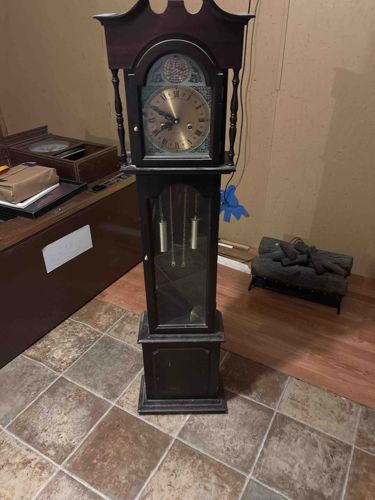
Grandfather Clock

Furniture and Timepieces

AI Estimated Value

·Not an official valuation·Verify before acting

$600-900

As of May 30, 2026

AI Item Analysis

·AI can make mistakes·Verify before acting
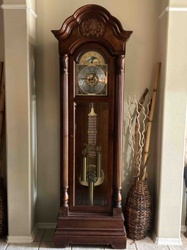
This is a freestanding grandfather clock, likely constructed from wood with a dark stain, possibly cherry or mahogany, judging by the reddish-brown hues visible in the carving details and general body. The top portion features a scalloped pediment or hood, a common design element for these clocks, with two turned finials or decorative columns flanking the face section. The clock face itself is brass-toned with black Roman numerals and minute markers, and appears to have a decorative, possibly engraved, brass plate surrounding the face. Above the main clock face, there is an arched dial with what looks like a moon phase or calendar complication, featuring intricate detailing. The middle section of the clock displays the pendulum and weights, encased behind a glass panel, allowing visibility of the internal mechanisms. Two polished brass weights and a pendulum bob are clearly visible, indicating a traditional mechanical movement. The base of the clock is a solid rectangular pedestal, also made of dark wood, providing stability to the tall structure. The overall style suggests a traditional or colonial period influence, likely from the mid-to-late 20th century. The condition appears to be generally good, though some dust is visible on the surface, and the wood finish shows minor signs of age and wear consistent with home use. There are no obvious major damages like cracks or significant chips visible from the provided image, but a closer inspection would be required to identify precise condition issues or manufacturing marks.
AI Appraisal Report

·AI can make mistakes·Verify before acting
I have visually examined the provided image of this grandfather clock. Based on its design, featuring a scalloped pediment, turned finials, brass-toned face with Roman numerals, and a moon phase complication, it presents as a traditional mechanical grandfather clock, likely dating from the mid-to-late 20th century. The dark wood, possibly cherry or mahogany, appears to be in generally good condition, with minor wear consistent with age and domestic use, such as some dust and superficial finish marks. Market conditions for grandfather clocks of this era are moderate. While once highly sought after, demand has somewhat softened, leading to a stable but not rapidly appreciating market. Comparables for well-maintained, mechanically sound clocks of similar traditional styling typically fall within the $600-$900 range in secondary markets. This specific piece does not appear to possess features that would indicate exceptional rarity or historical significance. The visible brass weights and pendulum suggest a traditional mechanical movement, which is generally more valued than quartz alternatives. The moon phase complication adds a desirable aesthetic and functional element. My primary limitation in this appraisal is the lack of physical examination. Without an in-person inspection, I cannot verify the operational integrity of the movement, confirm the wood type definitively, or identify any manufacturer's marks, which are crucial for precise dating and authentication. I also cannot assess internal wear or damage to the mechanism, nor can I definitively confirm authenticity regarding original parts versus replacements. A hands-on evaluation would involve checking movement functionality, chimes (if present), examining the case for structural integrity, and identifying any maker’s marks or serial numbers for more accurate dating and provenance verification.

Get your items appraised

Instant estimates of your treasures with AI-powered appraisals

Browse More Appraisals