These notes were written by the person who submitted this item. Appraiser.AI has not verified them, and the AI's identification and estimate may rely on them.
AI Estimated Value
Not an official valuation
$500-800
AI estimate as of September 7, 2025 · verify with a professional before acting
AI-Generated · Verify before acting
Everything on this page is generated by AI for informational purposes only. AI can make mistakes — the AI may misidentify items or misattribute them (artist, maker, brand, designer, origin, era). This is not an official valuation and should not be used for insurance, sale, tax, estate, legal, or lending purposes — or any decision requiring a certified appraisal. It is not an authoritative claim about any person, brand, or rights holder — do not share or rely on it as a factual statement about a third party. Always consult qualified professionals before making financial decisions.
This analysis also relies on unverified notes provided by the user, which may be incomplete or inaccurate and could affect the result.
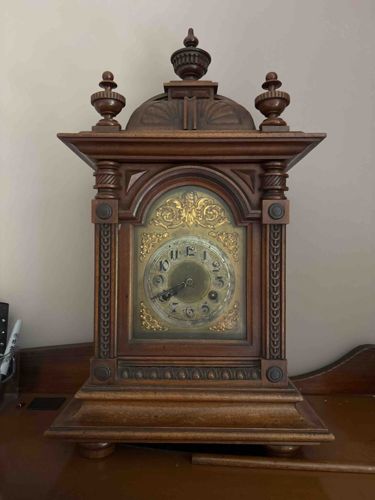
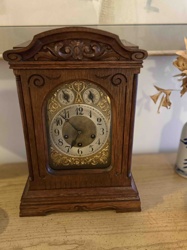
This is an elaborately carved wooden mantel clock, likely dating from the late 19th or early 20th century, consistent with the Victorian or Edwardian periods. The clock case is constructed from a dark, rich wood, possibly oak or walnut, exhibiting a warm brown hue and a visible wood grain. Its prominent architectural form features a rectangular body with decorative columns on either side of the dial, topped by a pediment-like structure with a scalloped or shell motif carving. The top is further adorned with three turned finials, one central and two flanking, adding to its grand and ornate appearance. The front of the clock showcases fine craftsmanship with intricate carvings, including reeded or fluted columns, ornate relief work above the dial, and a repeating pattern along the lower frieze and the base's edge. The clock face itself is set within a brass or gilded metal bezel, featuring an ornate, embossed or chased design around the perimeter of the dial, typical of the Art Nouveau or late Victorian aesthetic. The dial has Arabic numerals and what appear to be dark metal hands. The overall condition shows a visible patina consistent with age, suggesting some surface wear and perhaps minor scratches or dings, but no major structural damage or repairs are immediately apparent from the image. The wood appears to be well-preserved, and the metallic elements of the dial retain their decorative luster. The robust construction and detailed decorative elements indicate a high-quality piece of its era.
AI Appraisal Report
Based on my visual examination of the provided image, this Victorian Era Mantel Clock, likely dating from the late 19th or early 20th century, presents as a well-preserved example of its type. The elaborately carved case, possibly oak or walnut, exhibits a warm patina consistent with its age, with no immediate indications of major structural damage or repairs. The intricate carvings, including the reeded columns, relief work, and finials, demonstrate a high level of craftsmanship. The brass or gilded metal bezel around the dial, with its embossed design, is particularly appealing and aligns with late Victorian or Art Nouveau aesthetics. While surface wear, minor scratches, and dings are part of its vintage charm, they do not significantly detract from its overall appeal. The owner's information, ‘Coalport,’ is noted; however, without an explicit mark visible, I am assuming this refers to Coalport as the place of potential origin or initial retail rather than the manufacturer, as Coalport is primarily known for pottery, not clockmaking. If this refers to a specific clockmaker brand 'Coalport' that I am not familiar with, further research would be required.
In the current market, decorative antique mantel clocks from this period generally have steady demand, particularly pieces exhibiting architectural forms and intricate carvings. Comparables suggest that well-preserved examples without significant mechanical issues typically range from $500-$800. Factors positively impacting value include the intricate carving and good preservation of the wood and metallic elements. Negative factors would be the lack of a prominent, highly sought-after maker's mark and the absence of information regarding the clock's mechanical functionality.
It is crucial to note the limitations of this appraisal due to it being based solely on images. Full authenticity verification, a precise understanding of the clock's mechanical condition (whether it is working and keeping time accurately), and definitive identification of the movement's maker would necessitate an in-person examination. Thorough inspection for hidden repairs, woodworm, and analysis of the internal components are vital. Provenance documentation, if available, could significantly enhance its value by establishing its history. Without physical access, I cannot definitively verify the clockwork's originality or functionality, which are significant determinants of final value.