AI estimate as of September 27, 2025 · verify with a professional before acting
AI-Generated · Verify before acting
Everything on this page is generated by AI for informational purposes only. AI can make mistakes — the AI may misidentify items or misattribute them (artist, maker, brand, designer, origin, era). This is not an official valuation and should not be used for insurance, sale, tax, estate, legal, or lending purposes — or any decision requiring a certified appraisal. It is not an authoritative claim about any person, brand, or rights holder — do not share or rely on it as a factual statement about a third party. Always consult qualified professionals before making financial decisions.
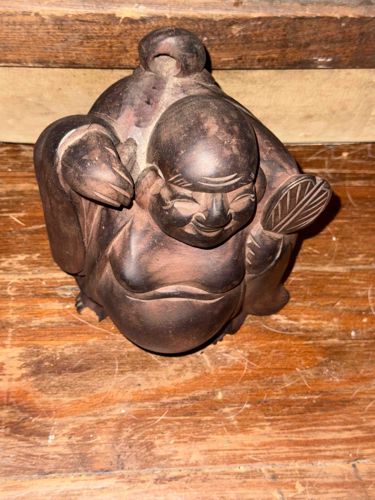
This is a carved wooden sculpture depicting Hotei, commonly known as the Laughing Buddha, in a playful embrace with a child. The sculpture is rendered in a dark, reddish-brown wood, possibly a type of rosewood or similarly dense, fine-grained hardwood, which has developed a rich, aged patina. The overall form is portly and jovial, characteristic of Hotei, with a prominent round belly. The Laughing Buddha is shown with a broad, serene smile and closed eyes, conveying a sense of inner peace and joy. His head is balding with some carved hair lines indicated around the temples. He is holding a child, who also appears to be smiling and holding a leaf or fan-like object in their right hand. The carving exhibits a good level of detail, particularly in the facial expressions and the texture of the child's object. There are no obvious visible cracks or significant damage, though surface wear consistent with age and handling is apparent, including some lighter areas where the wood's natural grain might be exposed or the outer layer of patination has worn thin. The construction is solid, appearing to be carved from a single block of wood, showcasing traditional craftsmanship. The style suggests an East Asian origin, likely Chinese or Japanese, embodying traditional iconography. The estimated age could range from mid-20th century to older, given the apparent wear and patination, though without specific maker's marks or provenance, a precise dating is challenging. The craftsmanship, while not overly intricate, demonstrates a skilled hand in capturing the essence of the figures.
AI Appraisal Report
Upon my visual examination of this carved wooden Hotei (Laughing Buddha) with a child, I assess it to be a skillfully executed piece, likely of East Asian, possibly Chinese, origin from the mid-to-late 20th century. The sculpture is carved from a dense, dark hardwood, exhibiting a pleasant aged patina and surface wear consistent with handling over time. The condition appears good, with no major cracks or repairs visible in the provided images. The carving quality is solid, capturing the joyful essence of Hotei, though it does not reach the level of exceptionally fine, master-level work. Market comparables for similar 20th-century Chinese decorative wood carvings of Hotei are readily available. While the subject is perennially popular, the market is saturated with examples of varying quality. This piece's value is supported by its good condition and charming composition but is limited by a lack of exceptional rarity or antiquity. The primary factor impacting a higher valuation is the absence of a known artist, workshop mark, or specific provenance. It stands as a quality decorative work rather than a museum-grade antique. It is critical to note that this appraisal is based solely on digital images. A definitive assessment of age, material, and authenticity would require in-person examination to study the tool marks, the patina under magnification, and the wood's specific type. Without provenance or the possibility of scientific dating (like radiocarbon testing, which would be destructive and not cost-effective for an item of this likely value), absolute verification remains limited.