AI estimate as of September 30, 2025 · verify with a professional before acting
AI-Generated · Verify before acting
Everything on this page is generated by AI for informational purposes only. AI can make mistakes — the AI may misidentify items or misattribute them (artist, maker, brand, designer, origin, era). This is not an official valuation and should not be used for insurance, sale, tax, estate, legal, or lending purposes — or any decision requiring a certified appraisal. It is not an authoritative claim about any person, brand, or rights holder — do not share or rely on it as a factual statement about a third party. Always consult qualified professionals before making financial decisions.
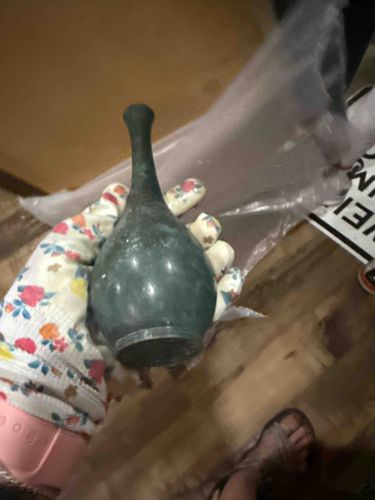
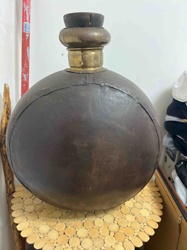
This appears to be a bottle-form vase or decanter, characterized by its bulbous body that tapers significantly into a slender neck, culminating in a slightly flared or rounded lip. The item is held by a gloved hand, providing some indication of scale, suggesting it is likely hand-held, possibly around 6-10 inches in height. The material appears to be metal, possibly bronze, brass, or copper, given the noticeable dark green to blackish patina that covers its entire surface. This heavy patination suggests considerable age or exposure to environmental elements. There are no visible decorative elements such as etchings, engravings, or applied ornamentations, indicating a preference for a minimalist or functional design, or perhaps a design where the material and form are the primary aesthetic focus. The surface texture appears somewhat mottled and uneven, consistent with an aged metallic object that has developed a natural coating over time. The base is simple and flat, providing stability. No distinct maker's marks, signatures, or stamps are discernible from the provided images. The condition issues primarily revolve around the heavy, possibly uneven, patination which, depending on its origin, could be considered desirable for its antique aesthetic or indicative of neglect. Its style and evident patina hint at an antique or vintage period, possibly late 19th to mid-20th century, though without clearer markings or material identification, it's difficult to pinpoint precisely. The craftsmanship seems solid and functional, focusing on the distinct silhouette of the bottle.
AI Appraisal Report
Upon visual examination of the images, this bottle-form vase presents an intriguing study in form and patina. The vessel, likely cast in a base metal such as bronze or brass, stands approximately 6 to 10 inches tall. Its primary feature is the heavy, dark green-to-black patina covering the surface. This patination appears organic and suggests significant age, possibly dating it to the late 19th or early 20th century. The minimalist design, focusing on the silhouette rather than ornamentation, is consistent with styles from that era, such as the Arts and Crafts or early Modernist movements. The overall condition appears stable, though the patina is uneven, which can be a desirable sign of natural aging to collectors.
The market for such items is moderate. Similar unmarked, patinated bronze or brass vases from this period typically sell in the low hundreds. The value is heavily influenced by the material, age, and quality of the patina. Without maker's marks, its value is primarily decorative and tied to its aesthetic appeal as an antique object. While its simple form is elegant, the lack of distinguishing features or a known origin limits its potential to attract high-end collectors.
It is crucial to note the limitations of an appraisal based solely on images. I cannot confirm the base metal, the exact age, or the authenticity of the patina without physical inspection. An in-person examination would allow for weighing the item, testing the metal, and looking for subtle tool marks or signatures under magnification. Scientific testing like X-ray fluorescence (XRF) could definitively identify the metal alloy and potentially help date the object, significantly impacting its value should it prove to be of a rare composition or from a notable workshop.