AI estimate as of September 19, 2025 · verify with a professional before acting
AI-Generated · Verify before acting
Everything on this page is generated by AI for informational purposes only. AI can make mistakes — the AI may misidentify items or misattribute them (artist, maker, brand, designer, origin, era). This is not an official valuation and should not be used for insurance, sale, tax, estate, legal, or lending purposes — or any decision requiring a certified appraisal. It is not an authoritative claim about any person, brand, or rights holder — do not share or rely on it as a factual statement about a third party. Always consult qualified professionals before making financial decisions.
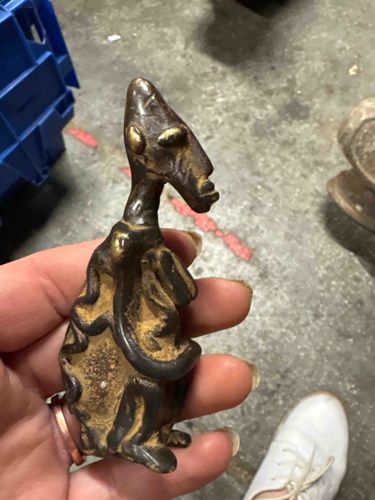
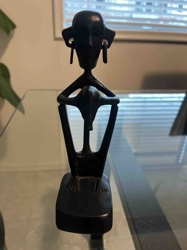
This item is a small, hand-held figurine, likely cast in a brass or bronze alloy due to its metallic luster and dark, aged patina, with visible golden highlights on raised areas. The figurine depicts an anthropomorphic figure, possibly a 'Nganga Nkishi' or a fertility figure, characteristic of certain African tribal art. It measures approximately 3-4 inches in height, fitting comfortably within an average adult's palm. The figure features an elongated, pointed head with minimal facial details, including raised ridges suggesting eyes, a small, prominent nose, and a slightly opened mouth. There are golden areas on the ears and along the jawline, indicating either selective polishing or a different, shinier metal inlay. The neck is slender and elongated, leading to a somewhat squat, rounded body. The 'body' appears to be heavily adorned or textured, almost organic and wave-like, with prominent ridges and curves that might represent clothing, scarification, or abstract anatomical features. There are two distinct, curved forms extending upwards from the body, perhaps stylized arms or other symbolic elements. The base is not clearly visible but seems to be flat enough for freestanding. The overall condition shows significant patination, with darker areas in the recesses and lighter, more golden tones on the high points, suggesting age and handling. There are no obvious signs of major damage such as breaks or repairs, though surface wear is evident. The craftsmanship appears hand-finished, with some irregularities typical of traditional tribal castings. The style points to a Sub-Saharan African origin, possibly from the Congo region, which is known for powerful and abstract sculptural forms.
AI Appraisal Report
Upon visual examination of the provided images, this small cast metal figurine, likely a brass or bronze alloy, presents as an African tribal piece, stylistically reminiscent of art from the Congo region, such as a 'Nganga Nkishi' or fertility figure. It measures approximately 3-4 inches and displays a heavy, dark patina with golden highlights, indicative of either artificial aging or genuine age and handling. The craftsmanship is consistent with hand-finishing, showing irregularities common in traditional castings.
However, it is crucial to note the limitations of an appraisal based solely on images. The market is saturated with tourist-grade reproductions and 'style' pieces made for export, which this could be. The patina, while visually compelling, can be artificially induced. Key factors that significantly impact value are authenticity, age, and specific cultural origin. Without provenance (a documented history of ownership), it is difficult to establish its use in a traditional context. Comparable authentic, well-documented figures from the early to mid-20th century can fetch thousands of dollars at auction. In contrast, decorative or tourist pieces typically sell for much less.
To confirm authenticity, a physical inspection is essential to assess the weight, casting method, and wear patterns more closely. Metallurgical analysis (XRF) could help date the alloy, and a thermoluminescence (TL) test on any core material would be definitive, though costly. Given the high probability of it being a decorative piece without provenance, I place its current fair market value in the decorative arts category. Further authentication could dramatically increase this value.