AI Appraisal Estimate

AI-generated estimates · not official valuations

From the user

What was submitted

Photo and notes provided by the user — not generated by AI

Submitted item photo
Submitted photo · June 21, 2026

User's notes

Unknown artist, untitled sculpture

AI analysis below

AI appraisal

AI analysis & estimate

AI-Generated · Verify before acting

Everything below is generated by AI for informational purposes only. AI can make mistakes — the AI may misidentify items or misattribute them (artist, maker, brand, designer, origin, era). This is not an official valuation and should not be used for insurance, sale, tax, estate, legal, or lending purposes — or any decision requiring a certified appraisal. It is not an authoritative claim about any person, brand, or rights holder — do not share or rely on it as a factual statement about a third party. Always consult qualified professionals before making financial decisions.

Note

This analysis also relies on unverified notes provided by the user, which may be incomplete or inaccurate and could affect the result.

Read the full disclaimer

AI Identification

·Not independently authenticated·Verify before acting

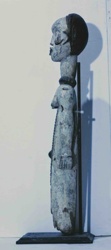
Lega-style Bwami Society Figurine

African Tribal Art / Ethnographic Sculpture

AI Estimated Value

·Not an official valuation·Verify before acting

$400 - $800

As of June 21, 2026

AI Item Analysis

·AI can make mistakes·Verify before acting
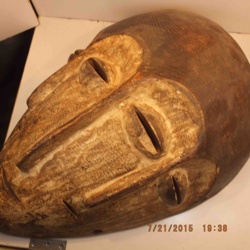
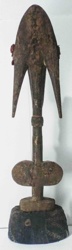
This is a hand-carved wooden anthropomorphic sculpture, stylistically attributed to the Lega people of the Democratic Republic of the Congo. The figure is carved from a single piece of dense, dark hardwood with a visible oily patina suggesting handling and ritual use. It features a highly abstracted heart-shaped face coated in remnants of white kaolin clay, which is a significant indicator of its use in the Bwami society ranks. The face contains two deeply recessed, dark ocular cavities flanking a long, narrow ridge-like nose. The body is stylized with a smooth, elongated torso and vestigial, downward-pointing arms. The lower half terminates in broad, squat legs with simplified feet. Surface texture reveals manual chiseling and sanding marks, characteristic of traditional craftsmanship. The condition shows significant age-related wear, including minor desiccation cracks, abrasions on the kaolin surface, and a darkened, encrusted patina across the dark wood areas. No maker's marks are present, which is common for tribal ceremonial objects of this period (mid-20th century or earlier). The piece lacks specific iconography, typical of the 'iginga' carvings used as mnemonic devices for teaching moral proverbs within the Bwami society.

AI Appraisal Report

·AI can make mistakes·Verify before acting
This appraisal concerns a wooden anthropomorphic figure attributed to the Lega people of the DRC, specifically associated with the Bwami society. Based on the provided imagery, the figure displays several formal characteristics consistent with Lega 'iginga' figures, notably the heart-shaped facial plane and the application of kaolin clay, which traditionally signifies purity and connection to the spirit world. The reported dense hardwood and oily handling patina are promising indicators of genuine ritual use rather than tourist production. The stylistic abstraction—recessed eyes, ridge nose, and columnar torso—aligns with the Lega aesthetic canon. However, authenticity cannot be definitively established without physical inspection. The market for African tribal art is currently bifurcated; while museum-quality masterworks command high prices, mid-range pieces with undocumented provenance face scrutiny. Similar mid-20th-century Lega figures lacking specific provenance (such as collection history or publication records) generally realize prices in the $400 to $800 range at auction. If this piece possessed concrete provenance dating back to the 1960s or earlier, the value could triple. To fully authenticate this item, I would require an examination of the wood's oxidation inside the desiccation cracks and a specific analysis of the kaolin's layering. Without scientific carbon dating or verifiable collection history, this piece is valued as a decorative ethnographic object likely of the mid-20th century, rather than a pre-contact masterpiece.

Get your items appraised

Instant estimates of your treasures with AI-powered appraisals

Browse More Appraisals