AI Appraisal Estimate

AI-generated estimates · not official valuations

From the user

What was submitted

Photo and notes provided by the user — not generated by AI

Submitted item photo
Submitted photo · June 23, 2026

User's notes

No additional notes provided.

AI analysis below

AI appraisal

AI analysis & estimate

AI-Generated · Verify before acting

Everything below is generated by AI for informational purposes only. AI can make mistakes — the AI may misidentify items or misattribute them (artist, maker, brand, designer, origin, era). This is not an official valuation and should not be used for insurance, sale, tax, estate, legal, or lending purposes — or any decision requiring a certified appraisal. It is not an authoritative claim about any person, brand, or rights holder — do not share or rely on it as a factual statement about a third party. Always consult qualified professionals before making financial decisions.

Read the full disclaimer

AI Identification

·Not independently authenticated·Verify before acting

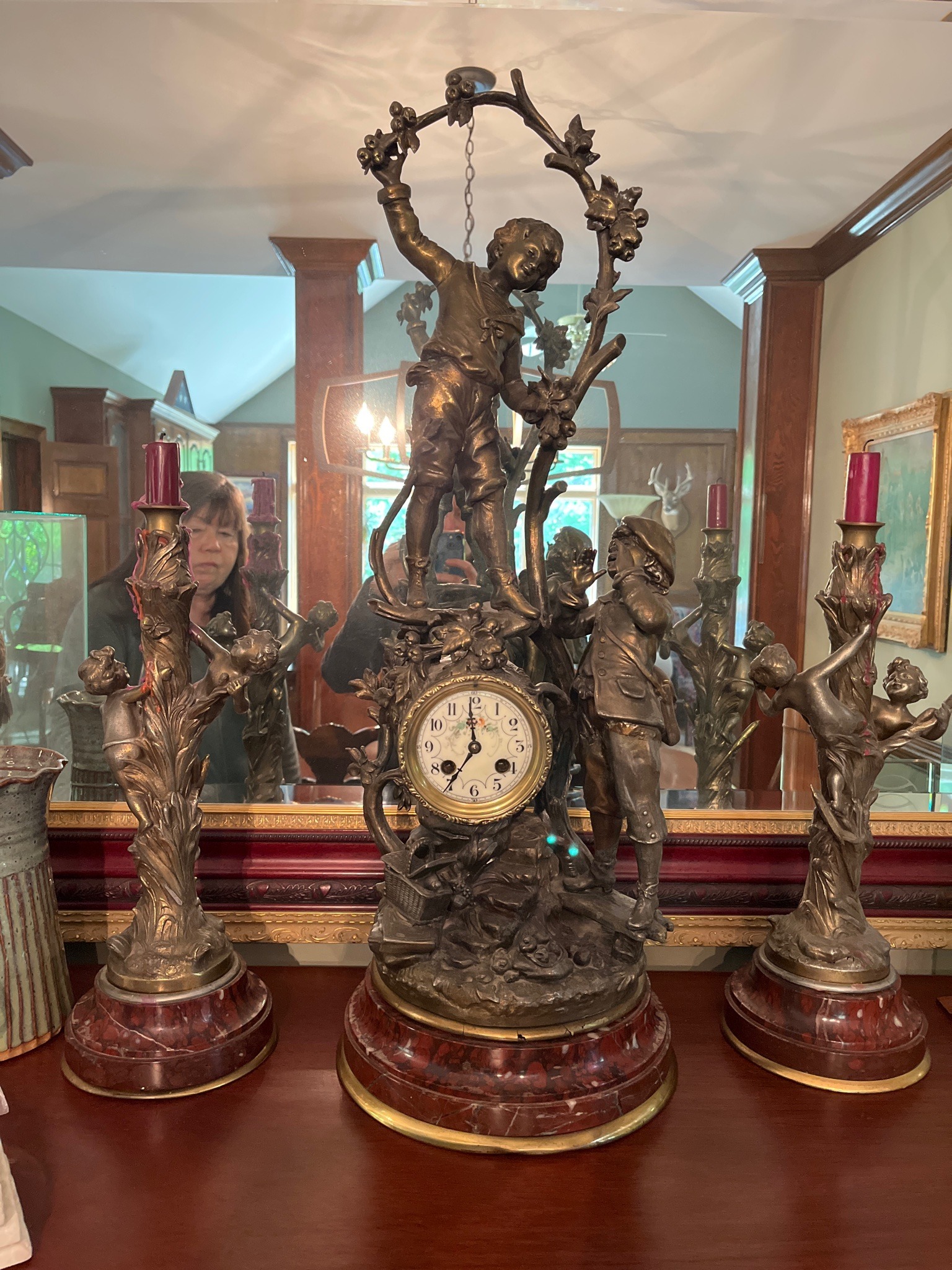
French Three-Piece Spelter and Rouge Marble Figural Mantel Clock Garniture Set

Antique Horology and Decorative Arts

AI Estimated Value

·Not an official valuation·Verify before acting

$400 - $600

As of June 23, 2026

AI Item Analysis

·AI can make mistakes·Verify before acting
A sophisticated three-piece clock garniture set featuring a central figural mantel clock flanked by two matching single-candle holders. The clock is designed in the late 19th-century French Rococo or Art Nouveau transition style. It features a central white enamel dial with Arabic numerals and delicate floral swags, housed in an ornate spelter (zinc alloy) case. The case is topped with a large figural sculpture of two boys harvesting fruit, adorned with intricate floral and vine motifs. The side garnitures depict cherub-like figures climbing stylized tree stumps that serve as candle sockets. All three pieces are mounted on circular, bevelled Rouge Marble bases with a deep red and white variegated pattern, finished with a brass or gilt-metal ring at the foot. The metal exhibits a dark bronze-toned patina with some visible highlights and minor surface wear consistent with age. Notable craftsmanship is seen in the casting of the figures' clothing and the organic curvature of the vines. The clock face appears to be in good condition, though the internal movement's functionality is unknown from the image alone. These sets were highly popular in bourgeois French households during the Belle Époque.
AI Appraisal Report

·AI can make mistakes·Verify before acting
Based on the provided images, I have examined this three-piece spelter and rouge marble clock garniture set. The casting exhibits typical Belle Époque characteristics, transitioning between late Rococo and Art Nouveau styles. The spelter (zinc alloy) retains a dark bronze-toned patina with some expected minor surface wear and highlights. The rouge marble bases appear intact and free of major fractures, which is a positive condition metric. The enamel dial is clean, though the internal movement's functionality is unverified. In the current antique market, spelter sets are much more widely available and carry significantly lower valuations compared to their solid bronze or ormolu counterparts. Similar late 19th-century French spelter garnitures typically realize between $300 and $600 at auction, depending heavily on the aesthetic appeal of the subject matter and the working condition of the movement. While complete three-piece sets remain desirable for traditional interior decorators, the overall market for antique clocks has softened over the last decade. The value of this garniture is supported by its completeness and the quality of the marble, but limited by the spelter material. Furthermore, I must note that this appraisal is based solely on photographic evidence. A definitive authentication and full valuation would require an in-person inspection. Physical examination is necessary to definitively verify the metal composition, inspect the movement for maker's marks, and test the mechanical functionality of the escapement and strike mechanism. Provenance documentation would also be required to fully establish the historical lineage of the piece.

Get your items appraised

Instant estimates of your treasures with AI-powered appraisals

Browse More Appraisals