AI Appraisal Estimate

AI-generated estimates · not official valuations

From the user

What was submitted

Photo and notes provided by the user — not generated by AI

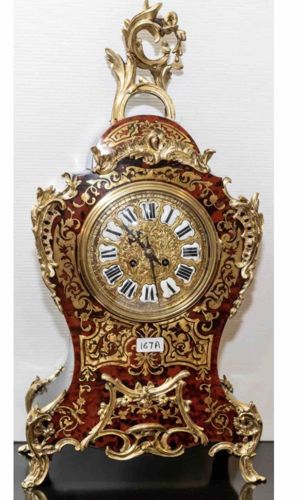
Submitted item photo
Submitted photo · May 24, 2026

User's notes

Large (68cm /25 inches high 32cm wide) Buhl French Salon Antique Clock Movement b by A.D. MOUGIN Deux Médailles

AI analysis below

AI appraisal

AI analysis & estimate

AI-Generated · Verify before acting

Everything below is generated by AI for informational purposes only. AI can make mistakes — the AI may misidentify items or misattribute them (artist, maker, brand, designer, origin, era). This is not an official valuation and should not be used for insurance, sale, tax, estate, legal, or lending purposes — or any decision requiring a certified appraisal. It is not an authoritative claim about any person, brand, or rights holder — do not share or rely on it as a factual statement about a third party. Always consult qualified professionals before making financial decisions.

Note

This analysis also relies on unverified notes provided by the user, which may be incomplete or inaccurate and could affect the result.

Read the full disclaimer

AI Identification

·Not independently authenticated·Verify before acting

French Boulle Marquetry Salon Pendule Clock by A.D. Mougin

Antique Horology / French Decorative Arts

AI Estimated Value

·Not an official valuation·Verify before acting

$4,500 - $6,500

As of May 24, 2026

AI Item Analysis

·AI can make mistakes·Verify before acting
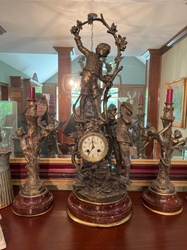
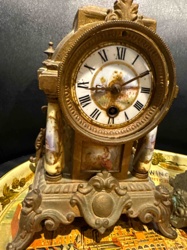
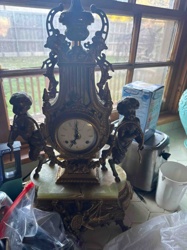
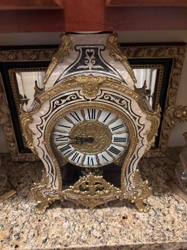
A magnificent late 19th-century French salon clock standing approximately 68cm tall and 32cm wide. This timepiece features a classic waisted 'religieuse' or balloon shape typical of Louis XV revival styles. The case is expertly crafted in the 'Boulle' technique, characterized by intricate tortoiseshell-colored grounds inlaid with ornate brass scrolling foliate patterns. It is heavily embellished with gilded ormolu (bronze doré) mounts, including a large scrolled acanthus leaf finial, C-scroll borders, and decorative floral feet. The dial is composed of twelve individual white enamel Roman numeral cartouches set into a gilt embossed brass center, featuring decorative pierced hands. The movement is marked by the prestigious maker A.D. Mougin, bearing the 'Deux Médailles' stamp, which signifies awards won at international exhibitions in the late 1800s. The overall craftsmanship is high, exhibiting the precision of French horology and cabinet making. The condition appears well-preserved with a rich patina to the brass and minor signs of age-appropriate wear to the marquetry surface. The gilding remains bright but may have slight rubbing on the high points of the mounts.
AI Appraisal Report

·AI can make mistakes·Verify before acting
Upon my virtual inspection of this late 19th-century French Boulle marquetry salon clock, I find it to be a superior example of Louis XV revivalism. Standing at a commandingly large 68cm, its presence is significant. The 'Boulle' technique of brass-in-tortoiseshell is expertly executed. The presence of the A.D. Mougin 'Deux Médailles' stamp on the movement is a hallmark of quality, indicating a production date post-1880 and pre-1900, a period where French horology merged industrial precision with high-art decorative cases. The condition appears remarkably well-preserved. The ormolu mounts retain their crisp definition, and the enamel cartouche dial—often a point of failure due to chipping—appears intact. In the current market, large-scale 'religieuse' clocks by recognized makers like Mougin maintain strong demand among collectors of Continental decorative arts, as they serve as focal centerpieces. High-quality comparables at specialized auctions typically fetch between $4,000 and $7,000 depending on the integrity of the movement and the state of the shell. However, a definitive valuation is limited by the digital format of this examination. A physical inspection is necessary to verify if the 'tortoiseshell' is genuine organic shell or a period-correct 'faux' celluloid, which began appearing in the late 19th century. Furthermore, I cannot verify the mechanical viability of the movement or the presence of the original pendulum and key. Full authentication would require removing the movement to inspect for serial number consistency and an ultraviolet light exam of the case to detect previous restorations or lifting in the brass inlays. Documentation regarding provenance or prior service history would further solidify this valuation.

Get your items appraised

Instant estimates of your treasures with AI-powered appraisals

Browse More Appraisals