AI Appraisal Estimate

AI-generated estimates · not official valuations

From the user

What was submitted

Photo and notes provided by the user — not generated by AI

Submitted item photo
Submitted photo · June 27, 2026

User's notes

No additional notes provided.

AI analysis below

AI appraisal

AI analysis & estimate

AI-Generated · Verify before acting

Everything below is generated by AI for informational purposes only. AI can make mistakes — the AI may misidentify items or misattribute them (artist, maker, brand, designer, origin, era). This is not an official valuation and should not be used for insurance, sale, tax, estate, legal, or lending purposes — or any decision requiring a certified appraisal. It is not an authoritative claim about any person, brand, or rights holder — do not share or rely on it as a factual statement about a third party. Always consult qualified professionals before making financial decisions.

Read the full disclaimer

AI Identification

·Not independently authenticated·Verify before acting

French Three-Piece Marble and Ormolu Neoclassical Clock Garniture

Antique Horology / Decorative Arts

AI Estimated Value

·Not an official valuation·Verify before acting

$4,500 - $6,500

As of June 27, 2026

AI Item Analysis

·AI can make mistakes·Verify before acting
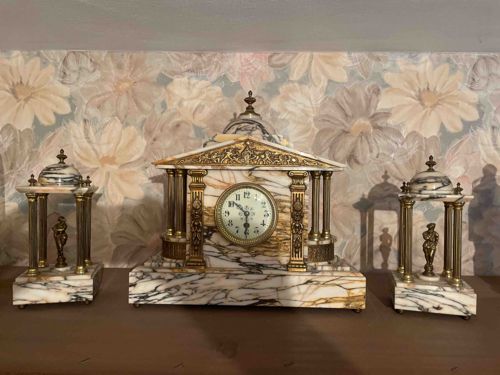
This is a lavish three-piece clock garniture set consisting of a central mantel clock and two matching side cassolettes, designed in the Neoclassical 'Temple' style. The pieces are constructed from heavily veined Breccia marble, primarily off-white with dramatic tan, brown, and grey inclusions. The clock serves as the centerpiece, featuring a pedimented architectural form supported by gilt-bronze (ormolu) fluted columns and ornate pilasters. The central clock face is housed in a circular brass bezel with a white enameled dial featuring Arabic numerals and decorative hands. Above the clock sits a marble dome with a bronze finial. The two accompanying flanking ornaments are designed as small open temples or rotunda-style cassolettes, each containing a small bronze-toned classical figure standing between columns. The craftsmanship is typical of late 19th-century French production, possibly Napoleon III era (circa 1870-1890). The metal components show a warm aged patina with some darkening, while the marble appears well-preserved with sharp edges and no immediately visible deep structural cracks, though surface dust and minor nibbles to the stone corners are consistent with its antique status. The intricate gilt-bronze friezes above the clock face and on the pilasters indicate high-quality casting. While no maker's mark is visible on the exterior, such sets often feature movements by makers like Japy Frères or S. Marti.
AI Appraisal Report

·AI can make mistakes·Verify before acting
I have conducted a visual examination of this French Three-Piece Neoclassical Clock Garniture, dating to approximately 1880 during the Napoleon III/Belle Époque era. The set demonstrates exceptional architecture, utilizing premium Breccia marble and high-quality fire-gilded ormolu mounts. The 'Temple' design is highly sought after by collectors for its architectural grandiosity. The condition appears remarkably well-preserved; the marble retains sharp profiles without the significant 'sugaring' or structural fracturing common in pieces of this age. The ormolu has developed a desirable aged patina, though it remains bright enough to suggest the original gilding is largely intact. In the current decorative arts market, French garniture sets of this scale and material quality remain stable, particularly those featuring architectural rotunda elements. Comparables from makers like Japy Frères or Samuel Marti consistently realize mid-four-to-low-five-figure sums at specialized horological auctions. The rarity of this specific set is enhanced by the presence of both side cassolettes containing classical figures, as these components are frequently lost or separated over time. Important Limitations: This appraisal is based solely on visual inspection of the exterior. A definitive valuation is contingent upon a physical examination of the movement (the 'works') to verify the maker’s stamp and mechanical viability. I cannot confirm if the escapement is original or if the strike train is operational without a hands-on winding test. Furthermore, while the marble appears authentic, ultrasonic testing would be required to rule out internal repairs. Provenance documentation or a signature on the movement backplate would serve to further solidify the upper end of the estimated value range.

Get your items appraised

Instant estimates of your treasures with AI-powered appraisals

Browse More Appraisals