AI Appraisal Estimate

AI-generated estimates · not official valuations

From the user

What was submitted

Photo and notes provided by the user — not generated by AI

Submitted item photo
Submitted photo · May 26, 2026

User's notes

No additional notes provided.

AI analysis below

AI appraisal

AI analysis & estimate

AI-Generated · Verify before acting

Everything below is generated by AI for informational purposes only. AI can make mistakes — the AI may misidentify items or misattribute them (artist, maker, brand, designer, origin, era). This is not an official valuation and should not be used for insurance, sale, tax, estate, legal, or lending purposes — or any decision requiring a certified appraisal. It is not an authoritative claim about any person, brand, or rights holder — do not share or rely on it as a factual statement about a third party. Always consult qualified professionals before making financial decisions.

Read the full disclaimer

AI Identification

·Not independently authenticated·Verify before acting

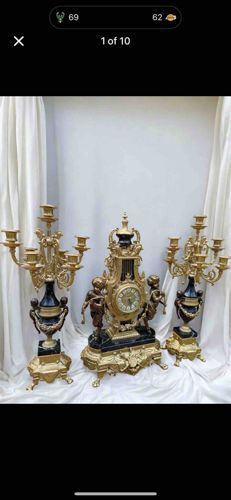
French Louis XV Style Ormolu and Marble Clock Garniture Set

Antique Decorative Arts / Horology

AI Estimated Value

·Not an official valuation·Verify before acting

$4,500 - $6,500

As of May 26, 2026

AI Item Analysis

·AI can make mistakes·Verify before acting
This elaborate three-piece clock garniture consists of a central mantel clock and a flanking pair of six-light candelabra, executed in a high-quality Louis XV Rococo style, likely dating to the late 19th-century (Napoleon III period). The central clock features a lyre-shaped patinated and gilt metal case, supported by two flanking cherub or putti figures. The clock face is white enamel with Roman and Arabic numerals, nested within an ornate ormolu frame with a crown-like finial and a foliate-scroll base resting on a dark marble plinth. The matching candelabra are designed with an urn-shaped black marble or patinated metal body, draped with ormolu floral swags and topped with six scrolling candle arms featuring petal-form bobeches. The construction utilizes high-relief cast bronze or spelter with a mix of burnished and matte gold finish (ormolu), contrasted against dark, possibly Belgian Black or Portoro marble bases. Notable features include the intricate 'C' curves, acanthus leaf motifs, and the figural elements which exhibit fine muscular definition. While the set appears complete, visible condition issues include minor surface oxidation on the gilding and potential dust accumulation in the crevices, which is typical for its age. The craftsmanship is indicative of high-tier Parisian decorative arts, showing balanced symmetry and complex casting techniques common in late 19th-century luxury interiors.
AI Appraisal Report

·AI can make mistakes·Verify before acting
I have conducted a visual analysis of this three-piece Louis XV-style clock garniture. Based on the ornate casting of the ormolu and the neoclassical 'Lyre' influence, I attribute this set to the French Belle Époque period, approximately 1880–1900. The craftsmanship reflects the high-tier quality of Parisian foundries such as those associated with the Marais district. The contrast between the patinated bronze, dark marble, and fire-gilded (ormolu) elements remains striking, with the putti figures showing excellent anatomical detail characteristic of professional bronze casters. Condition-wise, there is visible oxidation and minor wear to the gilding, consistent with age. Market demand for late 19th-century garnitures remains steady among decorators and collectors of European horology, though values are currently dictated more by the decorative appeal of the candelabra than the mechanical rarity of the movement. Recent auction comparables for Napoleon III marble and gilt-bronze sets of this scale typically realize between $4,000 and $7,000, depending on the maker's mark (e.g., Japy Frères or Farcot). Limitations: This appraisal is based solely on digital images. Without an in-person inspection, I cannot verify if the clock movement is original, complete, or functional. A physical examination is required to check for 'C' or 'S' stamps on the movement, which could significantly increase the valuation if a specific master clockmaker is identified. I recommend a professional horological cleaning and an inspection of the marble for hairline fractures or repairs that may not be visible in photos. Provenance documents or an original bill of sale would further solidify its market position.

Get your items appraised

Instant estimates of your treasures with AI-powered appraisals

Browse More Appraisals