AI Appraisal Estimate

AI-generated estimates · not official valuations

From the user

What was submitted

Photo and notes provided by the user — not generated by AI

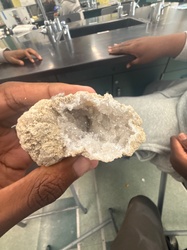
Submitted item photo
Submitted photo · June 3, 2026

User's notes

No additional notes provided.

AI analysis below

AI appraisal

AI analysis & estimate

AI-Generated · Verify before acting

Everything below is generated by AI for informational purposes only. AI can make mistakes — the AI may misidentify items or misattribute them (artist, maker, brand, designer, origin, era). This is not an official valuation and should not be used for insurance, sale, tax, estate, legal, or lending purposes — or any decision requiring a certified appraisal. It is not an authoritative claim about any person, brand, or rights holder — do not share or rely on it as a factual statement about a third party. Always consult qualified professionals before making financial decisions.

Read the full disclaimer

AI Identification

·Not independently authenticated·Verify before acting

Polished Agate Geode Half

Mineral/Geological Specimen

AI Estimated Value

·Not an official valuation·Verify before acting

$60 - $90

As of June 3, 2026

AI Item Analysis

·AI can make mistakes·Verify before acting
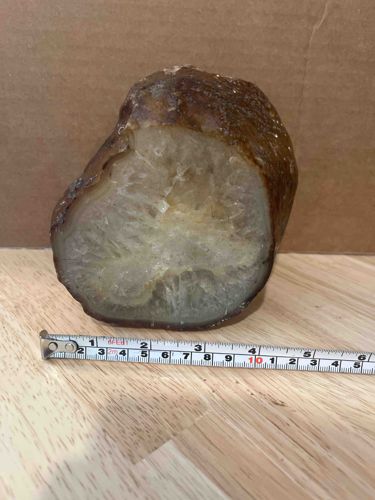
The item is a raw, cut and polished agate geode half, showcasing a prominent crystalline interior. Its physical characteristics include an irregular, organic outer shape typical of a natural geode, with one side having been cut smoothly and polished to reveal the internal structure. The exterior rind appears to be a dark, earthy brown to reddish-brown color, which transitions into a lighter, more translucent band before reaching the core. The exposed interior cavity is filled with translucent to milky white quartz crystals, likely chalcedony or microcrystalline quartz, forming a sparkly druzy surface. These crystals exhibit excellent clarity and an intricate, radiating growth pattern. The overall size of the specimen, measured by the tape measure visible in the image, is approximately 13-14 cm (around 5 to 5.5 inches) at its widest point. There are no visible condition issues such as chips, cracks, or significant wear on the polished surface. The natural outer rind shows the raw, unpolished texture of the original rock formation. No specific maker's marks, signatures, or stamps are discernible, which is typical for natural mineral specimens. Based on its appearance, it is a naturally occurring geological formation, likely millions of years old. The quality of the adularescence and the intricacy of the crystalline formations are indicators of a well-formed geode, making it suitable as a display piece or for a mineral collection.
AI Appraisal Report

·AI can make mistakes·Verify before acting
Upon visual examination of the provided image, this specimen is identified as a cut and polished agate geode half. The item appears to be in excellent condition, with a clean, well-polished face that reveals a high-quality druzy quartz interior. The crystalline structure is well-defined, and the transition from the dark outer rind to the translucent chalcedony banding and crystalline core is aesthetically pleasing. Based on these visual characteristics, the item appears to be a genuine, natural geode. The market for such decorative mineral specimens is quite active. Comparables of similar size (5-6 inches), quality of polish, and crystal clarity are commonly found in retail settings, including online marketplaces and specialty rock shops. The value is primarily driven by aesthetic appeal rather than exceptional rarity, as agate geodes of this type are relatively abundant. Key factors influencing its value are its size, the vibrancy of the crystals, and the quality of the finish. This piece is a strong example, suitable for display or as a collector's item. However, this appraisal is based solely on a photographic examination. A full authentication would require physical inspection to confirm the material's composition, check for any repairs or artificial enhancements (such as dyeing, which is not suspected here), and accurately assess its weight and three-dimensional presence. Without physical handling or provenance documentation, the possibility of it being a convincing replica, while unlikely, cannot be entirely dismissed. Spectroscopic analysis could confirm its mineralogical makeup if further verification were required.

Get your items appraised

Instant estimates of your treasures with AI-powered appraisals

Browse More Appraisals