AI estimate as of October 8, 2025 · verify with a professional before acting
AI-Generated · Verify before acting
Everything on this page is generated by AI for informational purposes only. AI can make mistakes — the AI may misidentify items or misattribute them (artist, maker, brand, designer, origin, era). This is not an official valuation and should not be used for insurance, sale, tax, estate, legal, or lending purposes — or any decision requiring a certified appraisal. It is not an authoritative claim about any person, brand, or rights holder — do not share or rely on it as a factual statement about a third party. Always consult qualified professionals before making financial decisions.
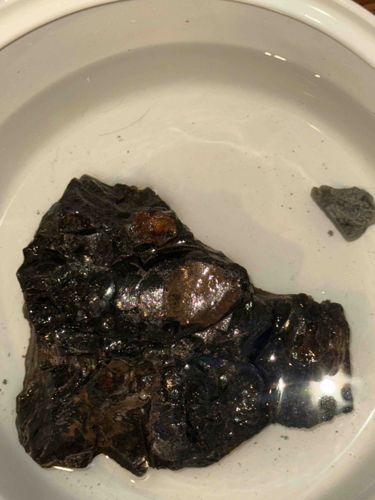
The item is a dark-colored, irregularly shaped mineral or rock specimen, predominantly dark brown to black in coloration. It appears to be submerged in a shallow layer of clear liquid within a white ceramic or plastic bowl. The surface of the specimen is highly textured and uneven, featuring a mix of rough, matte areas and smoother, somewhat glossy or reflective patches due to the liquid covering it. Several distinct, slightly lighter brown, almost amber-colored inclusions or crystal formations are visible embedded within the darker matrix, particularly towards the upper-central and right-central areas of the main mass. The overall form is amorphous, with no discernible geometric shape, suggesting a natural geological origin rather than a manufactured item. The size of the main specimen is approximately several inches across, occupying a significant portion of the bowl's bottom. A smaller, lighter gray, angular fragment is also present in the upper right corner of the bowl, separate from the main specimen, which may be a detached piece or unrelated debris. No specific manufacturing details, maker's marks, or signatures are visible. The specimen's condition appears natural; any 'wear' would be a reflection of its geological formation, though no obvious damage or post-collection alterations are evident from this view. Its exact composition is undeterminable without further testing, but its appearance resembles various types of ore, basalt, or possibly even very dark petrified wood fragments. The presence of the water suggests it might be undergoing a cleaning process, soaking, or simply being displayed in liquid to enhance its features or for some scientific purpose. The craftsmanship is naturally occurring.
AI Appraisal Report
I have examined the provided image of this Unidentified Dark Mineral or Rock Specimen. Visually, the specimen appears to be an authentic natural geological formation, exhibiting characteristics consistent with various terrestrial rocks or minerals such as ore, basalt, or potentially even very dark petrified wood fragments. Its irregular, amorphous shape and highly textured surface, with both matte and semi-glossy areas, support a natural origin. The visible, slightly lighter, almost amber-colored inclusions suggest crystal formations within a darker matrix. The condition appears to be as naturally formed, with no apparent damage or post-collection alterations. The presence of the specimen submerged in liquid in a bowl is noted, which could be for cleaning, research, or display purposes.
Authenticity, in this case, refers to its natural origin. Without in-person inspection or scientific testing, I cannot definitively identify the precise mineral or rock type, its specific gravity, hardness, or crystal structure. This is a significant limitation, as the specific identification is crucial for a precise valuation.
Market conditions for unclassified geological specimens like this are generally modest. While unusual shapes or rare mineral compositions can command higher prices, a generic dark rock specimen, even with interesting texture, typically has limited value without a definitive identification or provenance. Comparable items, such as unpolished river rocks, common geodes, or industrial slag pieces, often fall into a low price range. Demand is generally low for unidentified samples, unless they possess exceptional aesthetic appeal or are from a known significant geological site.
Factors significantly impacting value would include its precise geological classification (e.g., if it were confirmed to be a rare ore mineral, a specific type of meteorite fragment, or a unique fossilized material), its geographic origin, and any laboratory analysis confirming its composition. Without such information, its value remains primarily decorative or educational for a very generalized collection.
For full authentication and accurate valuation, an in-person examination by a professional geologist or mineralogist is essential. This would involve specific gravity tests, hardness tests, streak tests, and potentially X-ray diffraction (XRD) or scanning electron microscopy (SEM) analysis to determine its precise mineralogical composition. Documentation regarding its find location (provenance) would also be highly beneficial. Based solely on visual examination of the image as an unidentified geological specimen, I appraise its value in the range of $10 to $50.