AI estimate as of August 13, 2025 · verify with a professional before acting
AI-Generated · Verify before acting
Everything on this page is generated by AI for informational purposes only. AI can make mistakes — the AI may misidentify items or misattribute them (artist, maker, brand, designer, origin, era). This is not an official valuation and should not be used for insurance, sale, tax, estate, legal, or lending purposes — or any decision requiring a certified appraisal. It is not an authoritative claim about any person, brand, or rights holder — do not share or rely on it as a factual statement about a third party. Always consult qualified professionals before making financial decisions.
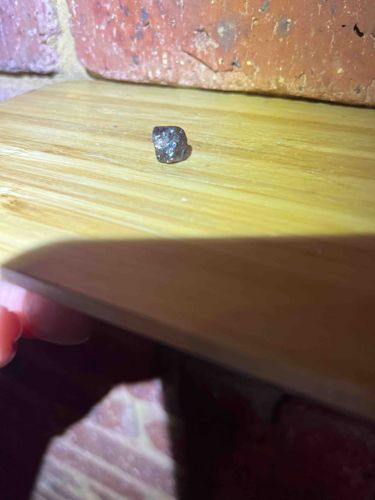
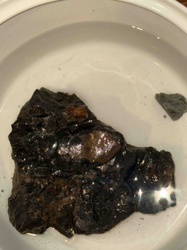
The item is a small, irregularly shaped fragment, possessing a dark, metallic luster. Its dimensions appear to be very small, likely less than a centimeter in its longest dimension, based on its context on a wooden surface, possibly a shelf, and next to a brick wall. The surface of the fragment is uneven, showing multiple facets and sharp angles, suggesting a natural crystalline formation or a fractured piece of a larger object. The color is predominantly dark grey or black, with hints of silver or bluish reflectivity in areas where light catches its surface, indicative of a metallic or semi-metallic composition. There are no discernible markings, inscriptions, or significant signs of wear or damage that would suggest it is a manufactured item or has undergone extensive handling. The raw, unrefined appearance points towards it being a natural specimen, possibly a mineral, a piece of ore, or even a small meteorite fragment. Its rough texture and angular form distinguish it from polished or tumbled stones. Given its appearance, it is likely a natural specimen rather than a crafted object, and its age would be geological, though its 'found' age is indeterminate.
AI Appraisal Report
Upon examining the provided image of this small, irregularly shaped dark metallic fragment, I observe characteristics consistent with a natural mineral specimen or possibly a small meteorite fragment. The dark grey/black color with silver/bluish reflectivity, multiple facets, and sharp angles suggest a crystalline or fractured geological origin rather than a manufactured item. Its condition appears stable, with no obvious signs of recent damage. Authenticity based solely on visual inspection is highly limited; while it presents as a natural specimen, definitive identification (e.g., specific mineral, ore, or meteorite) is impossible without physical examination. Factors significantly impacting value include its true identity, rarity, and aesthetic quality. If it were definitively identified as a rare mineral or a chondrite meteorite fragment, its value would increase. However, if it's common ore or slag, the value would be minimal. Market conditions for small, unverified geological specimens are low; collectors typically seek identified, provenance-rich, or visually striking pieces. Comparables are vast and range from virtually worthless common rocks to highly valued meteorites. Demand for unidentified fragments is negligible. To fully authenticate and assess value, in-person examination is crucial. I would need to perform specific gravity tests, streak tests, hardness tests, and potentially magnetic tests. For meteorite verification, a cut surface and microscopic examination of internal structures, along with elemental analysis (e.g., EDX, SEM), would be required. Provenance documentation, detailing where and when it was found, would also be highly beneficial.