These notes were written by the person who submitted this item. Appraiser.AI has not verified them, and the AI's identification and estimate may rely on them.
AI Estimated Value
Not an official valuation
$0.50 - $2.00
AI estimate as of November 10, 2025 · verify with a professional before acting
AI-Generated · Verify before acting
Everything on this page is generated by AI for informational purposes only. AI can make mistakes — the AI may misidentify items or misattribute them (artist, maker, brand, designer, origin, era). This is not an official valuation and should not be used for insurance, sale, tax, estate, legal, or lending purposes — or any decision requiring a certified appraisal. It is not an authoritative claim about any person, brand, or rights holder — do not share or rely on it as a factual statement about a third party. Always consult qualified professionals before making financial decisions.
This analysis also relies on unverified notes provided by the user, which may be incomplete or inaccurate and could affect the result.
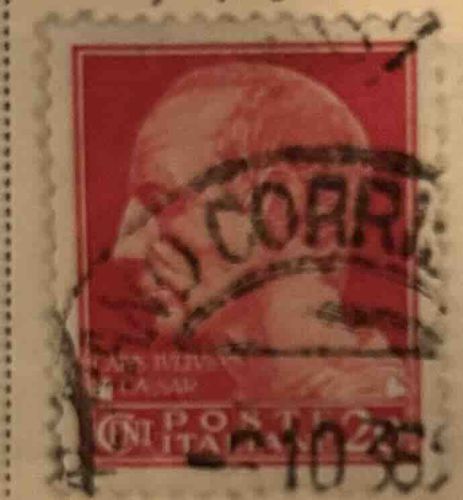
This item is a vintage Italian postage stamp, featuring a portrait of King Vittorio Emanuele III. The stamp is predominantly red in color with a rectangular shape and perforated edges, indicating its primary function as a postal artifact. The central image is a bust of King Vittorio Emanuele III, facing towards the left, depicted in a somewhat faded, lighter red shade against a darker red background. Below the portrait, the text "POSTE ITALIANE" is visible, confirming its country of origin, alongside a numerical denomination that appears to be "ONE IND" and "10" though the exact value is partially obscured. The stamp exhibits significant signs of post-use, including a prominent circular handstamp cancellation mark that reads "COBRE" or "CORRE" diagonally across the king's face, making the specific postmark location and date difficult to discern definitively. The perforation condition appears relatively intact, although some edges show minor wear consistent with handling and age. The overall condition suggests it is an authentic, used stamp, likely from the early to mid-20th century, given the reign of Vittorio Emanuele III (1900-1946). The paper quality seems standard for postage stamps of that era. The heavy cancellation mark, while obscuring some detail, is also an integral part of its philatelic history. The craftsmanship aligns with mass-produced governmental issues from that period.
AI Appraisal Report
I have examined the provided image of the Italian postage stamp featuring King Vittorio Emanuele III. Based on this visual inspection, the stamp appears to be an authentic, used Italian postage stamp from the early to mid-20th century, consistent with the reign of Vittorio Emanuele III. The design, including the portrait, 'POSTE ITALIANE' text, and perforated edges, aligns with known issues from that period.
The condition of the stamp is fair to good for a used item. There is a prominent circular handstamp cancellation mark that significantly covers the central portrait. While this cancellation mark is part of its philatelic history, its heavy and defacing nature typically reduces the aesthetic appeal and, consequently, the value for collectors seeking a crisp, clear image. The perforations appear relatively intact, with minor wear consistent with handling and age. The faded lighter red against a darker red background is likely due to the printing process and age rather than damage.
In terms of market conditions, stamps from King Vittorio Emanuele III's era are generally very common, especially used examples with heavy cancellations. This specific design is not considered rare. Over the past few decades, the market for common, heavily cancelled stamps has seen a decline in demand. Comparable stamps readily available in similar condition typically retail for under a few dollars.
The primary factor impacting value is the commonness of the issue and the heavy, defacing cancellation. While an authentic historical artifact, its philatelic market value is quite low due to these factors.
It is important to note that this appraisal is based solely on the provided image. For full authentication and a definitive assessment of condition, an in-person examination would be necessary to inspect paper quality, precise perforation details, watermark (if any), gum condition (though this is a used stamp), and to verify the exact shade and printing details. Without physical inspection, subtle print variations or potential alterations cannot be definitively ruled out, although such issues are less common with heavily cancelled, low-value stamps. Provenance documentation could theoretically add to the story but would not significantly impact the monetary value of such a common item.