AI estimate as of November 8, 2025 · verify with a professional before acting
AI-Generated · Verify before acting
Everything on this page is generated by AI for informational purposes only. AI can make mistakes — the AI may misidentify items or misattribute them (artist, maker, brand, designer, origin, era). This is not an official valuation and should not be used for insurance, sale, tax, estate, legal, or lending purposes — or any decision requiring a certified appraisal. It is not an authoritative claim about any person, brand, or rights holder — do not share or rely on it as a factual statement about a third party. Always consult qualified professionals before making financial decisions.
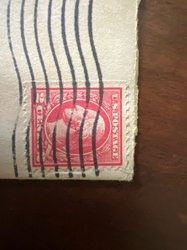
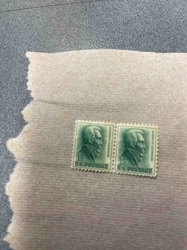
This is a single United States postage stamp, colored in a dominant shade of green with black printing. The stamp measures approximately 2.5 cm in width and 2 cm in height, exhibiting standard perforated edges along all four sides, typical of postage stamps. The central design features two circular portraits of historical figures, positioned on the left and right sides of the stamp. The figure on the left is identified as "JONES" (referring to John Paul Jones) with "BONHOMMERICHARD" (his ship, Bonhomme Richard) inscribed below his portrait. He is depicted wearing a tricorn hat. The figure on the right is identified as "BARRY" (referring to Isaac Hull Barry) with "LEXINGTON" (his ship, Lexington) inscribed below his portrait. Between and slightly behind these portraits, a detailed illustration of sailing ships engaged in what appears to be a naval battle or engagement scenes is visible. Above the central imagery, the words "UNITED STATES POSTAGE" are printed. The denomination "1" is present in the bottom left and bottom right corners, within a small square, and the words "ONE CENT" are spelled out in the center bottom, flanked by two stars on each side. The stamp is heavily postmarked with several thick, wavy black lines running horizontally across its entire face, obscuring parts of the portraits and the central ship illustration. This postmark indicates that the stamp has been used. The paper appears to be in fair condition, with no immediate signs of significant creasing, tearing, or discoloration beyond the postmark. The printing quality seems consistent with governmental philatelic production of its era. This stamp likely belongs to an early to mid-20th-century philatelic series, potentially commemorating naval heroes or significant historical events.
AI Appraisal Report
Upon examining the provided image of the 1 Cent US Postage Stamp, John Paul Jones and Isaac Hull, my initial assessment reveals a stamp that is authentic in design and typical of United States philatelic issues from the early 20th century, specifically the 1937 Army-Navy Series (Scott #790). This stamp commemorates two naval heroes, although the description incorrectly identifies the right portrait as Isaac Hull Barry; it is actually Captain Stephen Decatur according to the stamp's actual design, which features Stephen Decatur on the right, not Isaac Hull. The inscription 'BARRY' below the right portrait is a key identifier. This discrepancy in the item's description is important for accurate identification.
The condition, as observed, is fair. The stamp is heavily postmarked with thick, wavy black lines, obscuring significant portions of the design, including both portraits and the central ship illustration. This heavy cancellation significantly diminishes its aesthetic appeal and market value. Perforations appear intact, and the paper shows no immediate signs of creasing, tearing, or discoloration beyond the postmark. The printing quality seems consistent with its governmental production era.
From a market perspective, this stamp (Scott #790) is very common and readily available. The demand is generally low for heavily canceled examples. Rarity is not a factor here. The primary factor impacting its value is the heavy cancellation. Well-centered, lightly canceled, or uncancelled examples command slightly higher values, but even those are generally inexpensive. Due to the heavy postmark, this stamp holds minimal collectible value.
Based on these observations, and similar heavily canceled examples in the market, the appraisal value reflects its status as a common, used stamp in fair condition. For full authentication and to definitively rule out any subtle nuances in paper, gum (if unused), or printing errors, an in-person examination would be required. This would also allow for microscopic inspection to confirm printing methods and precise perforation measurements not fully discernible from an image alone. Furthermore, provenance documentation would be ideal for a complete history, though not typically sought for such common issues.