AI estimate as of November 8, 2025 · verify with a professional before acting
AI-Generated · Verify before acting
Everything on this page is generated by AI for informational purposes only. AI can make mistakes — the AI may misidentify items or misattribute them (artist, maker, brand, designer, origin, era). This is not an official valuation and should not be used for insurance, sale, tax, estate, legal, or lending purposes — or any decision requiring a certified appraisal. It is not an authoritative claim about any person, brand, or rights holder — do not share or rely on it as a factual statement about a third party. Always consult qualified professionals before making financial decisions.
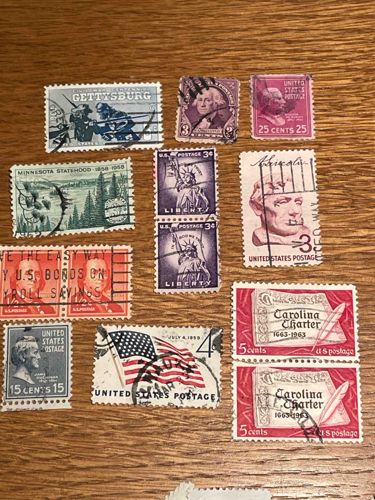
This item is a collection of approximately twelve vintage United States postage stamps, varying in denomination, design, and age. The stamps are primarily rectangular with perforated edges, a common characteristic of traditional postage stamps, suggesting they were intended for postal use. The colors vary widely, including shades of blue, green, purple, pink, red, and white, indicating different printing runs and designs. Many of the stamps exhibit cancellations, visible as black ink marks or lines, suggesting they have been used for postage. Some stamps are more heavily canceled than others, obscuring part of their design. There are no visible major tears or significant creasing, but some stamps show minor wear consistent with handling and age, such as slight corner bends or toning. Specific designs include: a 'Gettysburg' commemorative stamp depicting a battle scene in blue; 'Minnesota Statehood' (1858-1958) featuring a landscape in green; a red stamp promoting 'The Easy Way to Buy U.S. Bonds on Payroll Savings'; multiple purple stamps depicting the Statue of Liberty with 'Liberty' and a '3B' denomination; a pink stamp with "UNITED STATES POSTAGE 25 Cents 25" featuring a portrait; a brown/pink stamp with an image of Abraham Lincoln and a '3B' denomination; a gray stamp with 'UNITED STATES POSTAGE 15 CENTS 15' and a portrait (likely James Madison based on other similar stamps); a white stamp with a prominent American flag and 'July 4, 1959' and a '4B' denomination; and two red stamps for 'Carolina Charter 1663-1963' with a '5 cents' denomination. The overall condition suggests that they have been removed from envelopes or saved by a collector, but not necessarily in a pristine, un-canceled state. The stamps appear to be from the mid-20th century, with dates like 1958, 1959, and 1963 being explicitly visible on several stamps, placing them within the 1950s-1960s era. The varying designs and denominations highlight different historical events, figures, and themes relevant to the United States during that period. The clarity of the images and the consistency of the perforations suggest standard government-issued postage stamps.
AI Appraisal Report
I have examined the provided image of a collection of approximately twelve vintage United States postage stamps. Based on this visual examination, the stamps appear to be authentic government-issued postage from the mid-20th century, specifically the 1950s-1960s, indicated by visible dates like 1958, 1959, and 1963. The varying designs, denominations, and use of commemorative issues are consistent with US postal practices of that era.
The condition of these stamps is fair. Most exhibit cancellations, indicating they have been used for postage, which generally diminishes their value compared to unused examples. While there are no visible major tears or significant creasing, some stamps show minor wear, toning, and potentially slight corner bends, consistent with age and handling.
From a market perspective, these types of mid-century US used commemorative and definitive stamps are common and generally have low individual value. The collection itself, while diverse in design, does not contain any immediately identifiable rare denominations or significant printing errors. The demand for such common used stamps is typically satisfied by readily available and inexpensive examples.
Factors impacting value: The used nature of the stamps, their commonality, and the relatively recent issuance dates (historically speaking) all contribute to a lower market value.
It is important to note that this appraisal is based solely on visual information from the provided image. A full authentication and precise condition assessment would require in-person examination to verify paper quality, watermarks (if any), specific perforation counts, color accuracy, and to detect any repairs or hidden flaws not visible in the image. Provenance documentation, though unlikely for such common stamps, would also add to their verifiable history.