AI estimate as of November 8, 2025 · verify with a professional before acting
AI-Generated · Verify before acting
Everything on this page is generated by AI for informational purposes only. AI can make mistakes — the AI may misidentify items or misattribute them (artist, maker, brand, designer, origin, era). This is not an official valuation and should not be used for insurance, sale, tax, estate, legal, or lending purposes — or any decision requiring a certified appraisal. It is not an authoritative claim about any person, brand, or rights holder — do not share or rely on it as a factual statement about a third party. Always consult qualified professionals before making financial decisions.
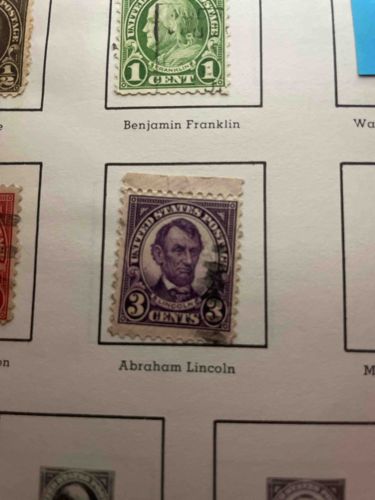
The item is a used United States postage stamp featuring a portrait of Abraham Lincoln, with a denomination of '3 CENTS'. The stamp is predominantly purple (lilac/mauve) in color, with a delicate scrollwork frame surrounding the central bust of Lincoln. The words 'UNITED STATES POSTAGE' curve around the top of the portrait, and the denomination '3 CENTS' is prominently displayed below it, flanked by two '3's in circles. The stamp exhibits a perforated edge, which appears somewhat irregularly torn or cut along the top and bottom, with more intact perforations on the left and right sides. There is visible wear and discoloration, particularly a dark mark or cancellation in the lower right quadrant of the stamp, covering part of the '3 CENTS' text and the surrounding frame. The paper shows signs of age-related toning, appearing slightly off-white or yellowish. Given the purple color and the Lincoln portrait, this stamp likely belongs to the Fourth Bureau Issue (perf. 10) of US postage stamps, commonly issued in the 1910s and 1920s. Its condition, with the heavy cancellation and irregular edges, suggests it circulated as intended for postal use. The printing quality appears consistent with early 20th-century philatelic production, characterized by a detailed engraving style for the portrait.
AI Appraisal Report
Upon visual examination of the provided image, I assess this Abraham Lincoln 3 Cents US Postage Stamp as a circulated example of Scott #427 or #428, part of the Fourth Bureau Issue (1912-1922). The lilac/mauve color, Lincoln portrait, and '3 CENTS' denomination are consistent with these common issues.
**Condition and Authenticity:** The stamp's authenticity appears probable for the type. However, its condition is poor. The perforations are torn and irregular, particularly at the top and bottom. There's significant visual wear, discoloration, and a heavy, dark cancellation mark in the lower right, obscuring much of the denomination and frame. This heavily canceled state significantly degrades its aesthetic appeal and market value. Authenticity cannot be definitively verified from images alone; an in-person examination would be needed to assess paper type, watermark (if any, though unlikely for these issues), and printing method to exclude facsimiles or forgeries.
**Market Conditions and Comparables:** This specific issue is extremely common, with millions printed. Used examples in fine-to-very-fine condition typically retail for under a dollar. Given the poor condition of this particular stamp, its market value is minimal. Comparable stamps in similar heavily canceled and damaged states typically sell for minimal sums, often in 'mixture' lots or for starter collections.
**Demand and Rarity:** There is virtually no rarity associated with common examples of this stamp, even in pristine condition. Demand for heavily damaged or canceled examples like this is very low among serious collectors, primarily limited to those seeking cheap 'space fillers' or for educational purposes.
**Factors Impacting Value:** The primary factor negatively impacting value is its poor condition, specifically the heavy cancellation, torn perforations, and general wear. This prevents it from achieving even the modest values of well-preserved used examples.
**Limitations:** Without physical inspection, I cannot confirm paper type, specific perforation count (though it appears to be perf. 10), or rule out re-perforations or repairs. A physical examination could also confirm the specific Scott number (e.g., distinguishing #427 from #428 through color nuances, though not critical for a low-value item), and definitively verify the cancellation mark’s genuineness. Provenance documentation is not typically available or required for such common items.