AI Appraisal Estimate

AI-generated estimates · not official valuations

From the user

What was submitted

Photo and notes provided by the user — not generated by AI

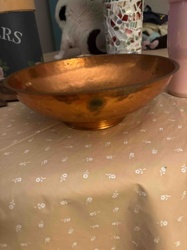
Submitted item photo
Submitted photo · June 6, 2026

User's notes

No additional notes provided.

AI analysis below

AI appraisal

AI analysis & estimate

AI-Generated · Verify before acting

Everything below is generated by AI for informational purposes only. AI can make mistakes — the AI may misidentify items or misattribute them (artist, maker, brand, designer, origin, era). This is not an official valuation and should not be used for insurance, sale, tax, estate, legal, or lending purposes — or any decision requiring a certified appraisal. It is not an authoritative claim about any person, brand, or rights holder — do not share or rely on it as a factual statement about a third party. Always consult qualified professionals before making financial decisions.

Read the full disclaimer

AI Identification

·Not independently authenticated·Verify before acting

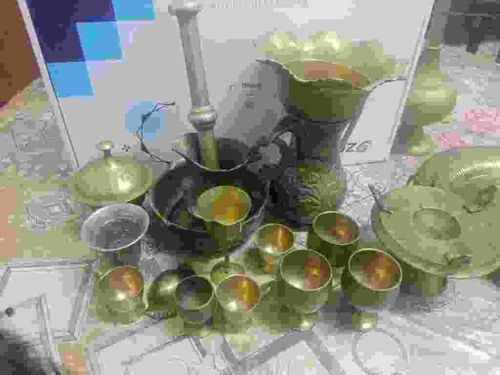
Vintage Brass Turkish Coffee and Tea Service Set with Mortar and Pestle

Antique and Vintage Metalware / Kitchenalia

AI Estimated Value

·Not an official valuation·Verify before acting

$450 - $650

As of June 6, 2026

AI Item Analysis

·AI can make mistakes·Verify before acting
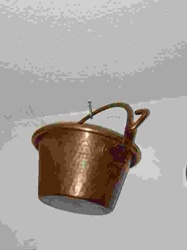
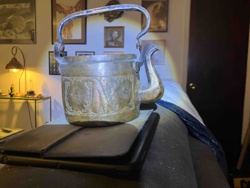
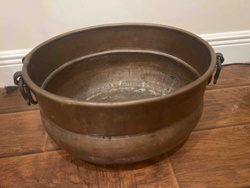
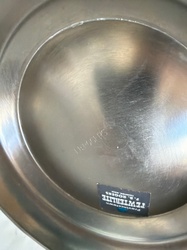
This is a diverse collection of vintage brass-ware, likely of Middle Eastern or Mediterranean origin, featuring a large coffee dulla (ewer), a mortar and pestle, numerous small cups/goblets, and lidded containers. The primary material is a patinated yellow brass with evidence of hand-tooling and engraving, particularly visible on the body of the tall ewer which exhibits floral or scrolling motifs. The set includes approximately eight small flared drinking cups with pedestal bases, a heavy-walled mortar with a coordinating bulbous pestle, and several shallow lidded bowls that may have served as sugar cellars or incense burners. The color ranges from a bright golden hue to deep brownish-green oxidation, indicating significant age and exposure to air. The construction techniques appear traditional, with visible seams and hand-hammered textures. Condition is aged with a heavy atmospheric patina throughout; there are various dark spots of tarnish and surface oxidation. No specific manufacturer marks are visible in the low-resolution image, but the style is consistent with mid-20th-century artisan metalwork from regions such as Turkey, Iran, or India. The craftsmanship displays a high level of detail in the repoussé work of the larger vessels, though the set shows signs of heavy use and storage wear over several decades.
AI Appraisal Report

·AI can make mistakes·Verify before acting
I have virtually examined this vintage brass service set, consisting of a traditional dulla, mortar and pestle, and associated vessels. The collection exhibits characteristic hand-chased and repoussé ornamentation consistent with mid-20th-century Middle Eastern or Anatolian craftsmanship. My assessment of the deep atmospheric patina and surface oxidation suggests an age of approximately 60 to 80 years. The heavy-walled construction of the mortar and the intricate floral motifs on the ewer indicate a higher grade of artisan work than modern mass-produced souvenir sets. The current market for 'Kitchenalia' and decorative brass remains stable, though buyers increasingly favor pieces with a genuine 'aged' aesthetic over polished finishes. Comparable sets from the 1940s-1960s typically realize mid-range prices at boutique auctions and through vintage dealers. The inclusion of the mortar and pestle adds significant value, as these functional pieces are currently in high demand for rustic interior styling. Factors impacting value include the comprehensive nature of the set (8 matching cups) versus the presence of uneven oxidation and minor pitting, which may require professional conservation to prevent further degradation. There is no evidence of structural cracks or catastrophic lead-solder repairs visible in the current imagery. Limitations: This appraisal is based solely on visual evidence. A full physical inspection is required to determine the presence of maker's marks, verify the exact metallurgical composition, and ensure the interior linings (if any) are food-safe. Authenticity of age could be further supported through provenance documentation or chemical analysis of the patina to rule out modern artificial aging techniques.

Get your items appraised

Instant estimates of your treasures with AI-powered appraisals

Browse More Appraisals