AI estimate as of December 4, 2025 · verify with a professional before acting
AI-Generated · Verify before acting
Everything on this page is generated by AI for informational purposes only. AI can make mistakes — the AI may misidentify items or misattribute them (artist, maker, brand, designer, origin, era). This is not an official valuation and should not be used for insurance, sale, tax, estate, legal, or lending purposes — or any decision requiring a certified appraisal. It is not an authoritative claim about any person, brand, or rights holder — do not share or rely on it as a factual statement about a third party. Always consult qualified professionals before making financial decisions.
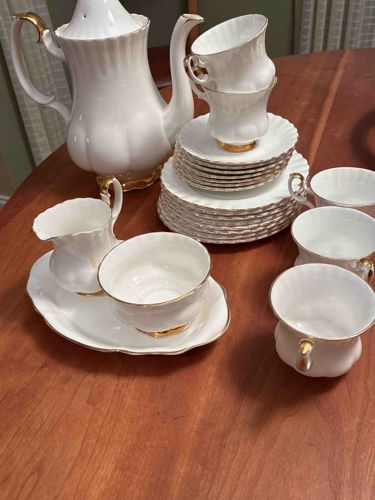
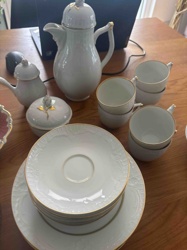
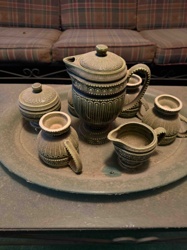
This is a comprehensive tea or coffee set, likely made of porcelain or fine china, characterized by its elegant white body and delicate gold-rimmed detailing. The set includes a tall, lidded coffee/teapod with a prominent handle and spout, featuring a fluted or ribbed design on the lower portion of its body and lid, and a gilded handle and finial. The pot has a curvaceous silhouette, appearing to be around 10-12 inches tall. There's also a creamer, small in size with a matching fluted design and gold trim on its handle and rim, and a sugar bowl (or another cup) that rests on an oval-shaped, scalloped tray, both adorned with gold accents. A significant portion of the set consists of multiple teacups and matching saucers, stacked neatly. The cups exhibit a flared rim and some appear to have a textured or fluted exterior, with small, gilded handles and gold bands at their bases and rims. The saucers similarly feature a scalloped edge and gold trim. At least two additional open cups are visible, one with a more pronounced footed design and a small, decorative gilded handle. The overall condition appears good, with no immediately visible chips, cracks, or significant wear to the gold detailing, suggesting either careful use or a relatively well-preserved state. The style points to a classical or perhaps mid-20th century aesthetic, emphasizing sophistication and traditional design. The craftsmanship appears to be of good quality, with consistent application of the gold trim and uniform ceramic bodies. The white color suggests versatility, while the gold accents add a touch of luxury and formality.
AI Appraisal Report
I have examined the provided images of this White and Gold Rimmed Porcelain Tea/Coffee Set. Based on my visual assessment, the condition appears to be very good to excellent. I observe no obvious chips, cracks, or significant wear to the gold detailing, suggesting either very careful handling or excellent preservation. The consistency in the application of the gold trim and the uniform ceramic bodies indicate good quality craftsmanship.
This set’s classical design, emphasizing white porcelain with elegant gold accents and fluted details, suggests a mid-20th century aesthetic, possibly dating from the 1950s to 1970s. Sets of this style are relatively common, particularly from European or Asian manufacturers during this period. The completeness of the set, including multiple cups and saucers, a creamer, sugar bowl, and the main coffee/teapot, enhances its appeal. However, without maker's marks, it is challenging to attribute it to a specific, highly collectible manufacturer.
Market conditions for such sets generally reflect a steady, but not soaring, demand among collectors and home decorators seeking traditional elegance. While attractive, the absence of identifiable rare patterns or a renowned maker prevents it from commanding premium prices. Comparable sets from un-identified or lesser-known manufacturers typically sell in the $200-$500 range, depending on condition and completeness.
Limitations exist in authenticating provenance and maker without physical inspection. I cannot confirm the specific porcelain type, origin, or exact age from images alone. An in-person examination would allow for inspection of maker's marks, assessment of the true depth and texture of the fluting, and a more definitive evaluation of any hairline cracks or minor wear not visible in photographs. Provenance documentation, if available, would significantly aid in verifying authenticity and potentially increasing value, especially if linked to a notable manufacturer or history. Scientific testing, while not typically applied to standard dinnerware, could confirm material composition if authenticity were genuinely in question, though it's unlikely to be necessary here.