AI estimate as of November 10, 2025 · verify with a professional before acting
AI-Generated · Verify before acting
Everything on this page is generated by AI for informational purposes only. AI can make mistakes — the AI may misidentify items or misattribute them (artist, maker, brand, designer, origin, era). This is not an official valuation and should not be used for insurance, sale, tax, estate, legal, or lending purposes — or any decision requiring a certified appraisal. It is not an authoritative claim about any person, brand, or rights holder — do not share or rely on it as a factual statement about a third party. Always consult qualified professionals before making financial decisions.
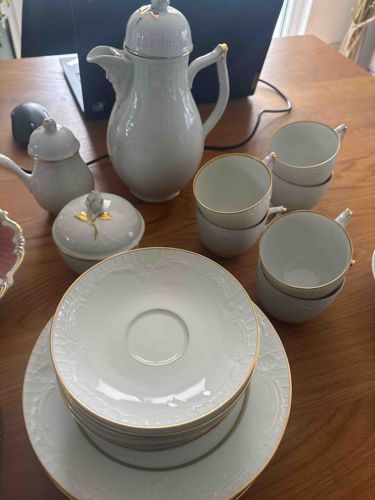
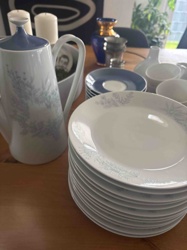
This appears to be a vintage white porcelain coffee or tea set, characterized by its elegant design and gold accents. The set includes a tall, slender coffee/tea pot with a matching lid topped with a delicate finial, a smaller creamer or milk jug with a handle and spout, a lidded sugar bowl, at least six cups, and a stack of coordinating saucers, along with a stack of larger plates. All pieces are crafted from what appears to be fine white porcelain, exhibiting a smooth, glazed finish. Each item features a consistent decorative motif of subtle, embossed floral or scroll patterns visible on the rims of the plates and saucers, and possibly around the bodies of the larger serving pieces. A striking detail is the consistent application of a thin gold band along the rim of all cups, saucers, and plates, and outlining the handles and spouts of the serving vessels. The finials on the lids of the coffee/tea pot and sugar bowl also incorporate gold highlights, possibly in the shape of a rose or another floral element. The condition appears to be good with a consistent patina, suggesting age but no obvious chips or cracks from the visible angles. The overall style points to a classic design, possibly mid-20th century, emphasizing refinement and traditional porcelain craftsmanship. The uniform pattern and gold trim suggest it is a complete or nearly complete set from a single manufacturer, though no specific maker's marks are discernible from the images.
AI Appraisal Report
I have examined the provided image of the vintage white porcelain coffee/tea set with gold trim. Visually, the set appears to be in good condition, with a consistent patina suggesting age but no obvious chips, cracks, or significant wear visible from the angles provided. The gold trim appears largely intact, which is a positive indicator. The design, featuring embossed floral or scroll patterns and gold banding, suggests a classic style, likely dating to the mid-20th century.
Authenticity, based solely on visual examination of images, is difficult to confirm definitively. The absence of discernible maker's marks is a limitation; these marks are crucial for identifying the manufacturer, origin, and often the specific pattern, all of which significantly impact value. Without them, it's challenging to assess its true provenance or compare it directly to known, authenticated sets.
Market conditions for vintage porcelain coffee/tea sets are generally moderate unless they are from highly sought-after manufacturers (e.g., Limoges, Wedgwood, Royal Albert) or represent unique artistic merit. This set, while attractive, appears to be a more common decorative style. Demand for such unbranded sets is driven primarily by aesthetic appeal and completeness rather than rarity. Comparables for generic mid-century porcelain sets in good condition typically range from $75 to $200, depending on the number of pieces and overall presentation.
Factors impacting value include the good visible condition and the completeness of the set. However, the lack of identifiable maker's marks is the most significant limiting factor. To fully authenticate and accurately value this set, an in-person examination would be necessary to inspect for hidden damage, assess the quality of the porcelain and gold application up close, and crucially, locate any maker's marks. Provenance documentation, if available, such as original sales receipts or family history, would also be invaluable. Scientific testing, like material analysis, is generally not required for this type of item unless there are specific concerns about its composition.