AI estimate as of September 22, 2025 · verify with a professional before acting
AI-Generated · Verify before acting
Everything on this page is generated by AI for informational purposes only. AI can make mistakes — the AI may misidentify items or misattribute them (artist, maker, brand, designer, origin, era). This is not an official valuation and should not be used for insurance, sale, tax, estate, legal, or lending purposes — or any decision requiring a certified appraisal. It is not an authoritative claim about any person, brand, or rights holder — do not share or rely on it as a factual statement about a third party. Always consult qualified professionals before making financial decisions.
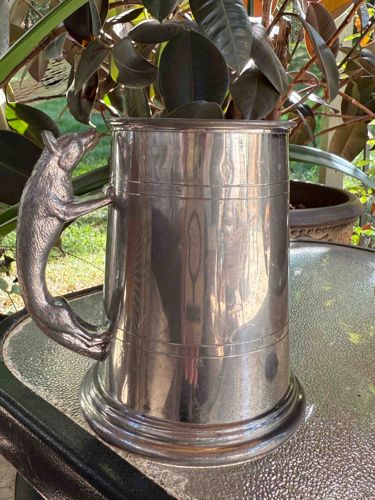
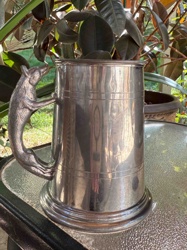
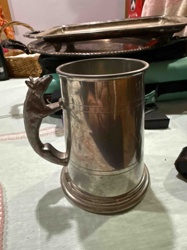
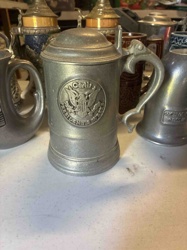
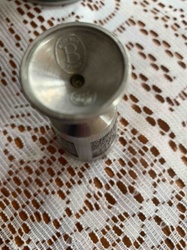
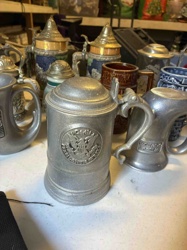
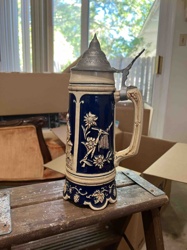
This is a pewter tankard featuring a highly distinctive handle in the form of a rat, climbing up the side of the vessel. The tankard itself is cylindrical with a slightly tapering body and a prominent, flared base, characteristic of traditional tankard designs. The material appears to be pewter, judging by its dull silver-grey color and matte luster, which is typical for this lead-free alloy that ages with a distinctive patina. Two incised lines, likely decorative bands, encircle the body of the tankard, one positioned roughly a third of the way down from the rim and another closer to the base, adding a touch of understated elegance. The rat handle is the most striking feature; the creature is depicted in a naturalistic pose, with its forepaws gripping the rim and its elongated body forming the handle, terminating in a coiled tail that curls around the lower part of the vessel. Details such as fur texture, ears, eyes, and paws are sculpted with a good level of realism, suggesting quality craftsmanship. The tankard shows signs of age and handling, including a visible patina across its surface, which is consistent with old pewter and adds to its character. There are minor scuffs and scratches visible, particularly on the main body of the tankard, as well as some light discoloration that might be indicative of oxidation or residue from previous use. No specific maker's marks or signatures are immediately discernible from the provided image, which would require a closer physical inspection for identification. The style suggests it could be a novelty item or a piece from the late 19th to mid-20th century, drawing inspiration from medieval or Renaissance drinking vessels but with a whimsical, perhaps 'quirky' twist provided by the animal handle. The overall design suggests a functional item that could also serve as a decorative piece, potentially for a bar, study, or collector's display. The quality of the casting for the rat handle is notably fine, indicating a skilled artisan.
AI Appraisal Report
I have examined the provided image of this pewter tankard with a distinctive rat handle. The tankard appears to be in good, aged condition, consistent with what one would expect from an antique or vintage pewter piece. The dull silver-grey color and matte luster, along with the visible patina and minor scuffs/scratches, attest to its age and handling. The two incised decorative lines suggest a design influence from traditional tankards. The rat handle is clearly the key feature, exhibiting fine detail in its sculpting, indicating quality craftsmanship. While the artistic rendering is impressive, the overall aesthetic leans towards a novelty item rather than a high-end decorative art piece. Authenticity as genuine pewter is strongly suggested by its appearance, but without physical inspection, I cannot confirm the exact alloy composition. Market comparables for novelty pewter tankards, especially those with animal motifs, tend to fall within a moderate range. Items with unique and well-executed designs like this rat handle attract collectors of quirky or unusual barware and decorative collectibles. Demand for such pieces is steady but not exceptionally high, limiting its rarity in the broader antique market. Factors impacting value include the material (likely lead-free pewter, which is desirable), the unique and sculptural rat handle, and its overall good patinated condition. The absence of maker's marks, which often elevate value, is a limiting factor. For full authentication, an in-person examination would be crucial to look for any hidden marks, assess the exact weight and feel of the metal, and potentially perform a metal analysis if there were any doubts about it being pewter. Without provenance documentation, its precise age remains an estimate, but the style suggests late 19th to mid-20th century.