AI estimate as of August 1, 2025 · verify with a professional before acting
AI-Generated · Verify before acting
Everything on this page is generated by AI for informational purposes only. AI can make mistakes — the AI may misidentify items or misattribute them (artist, maker, brand, designer, origin, era). This is not an official valuation and should not be used for insurance, sale, tax, estate, legal, or lending purposes — or any decision requiring a certified appraisal. It is not an authoritative claim about any person, brand, or rights holder — do not share or rely on it as a factual statement about a third party. Always consult qualified professionals before making financial decisions.
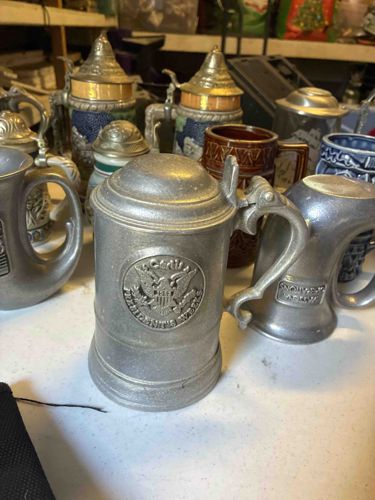
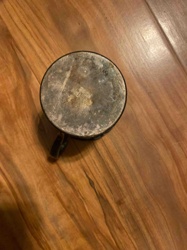
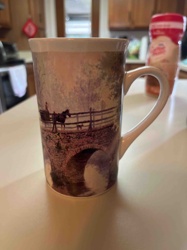
The item prominently displayed in the foreground is a pewter tankard or stein, characterized by its cylindrical body, hinged lid, and robust handle. Its surface exhibits the dull, silvery-gray patina typical of aged pewter, suggesting a significant older vintage and likely good care over time. The main body of the tankard features a circular raised emblem on the front, depicting the Seal of the United States with an eagle clutching arrows and an olive branch, encircled by text that appears to read "UNITED STATES" at the bottom, though the top portion is less clear. This suggests a patriotic or military affiliation. The hinged lid is also made of pewter and has a simple, somewhat domed profile. The handle is an integral part of the design, featuring a decorative thumb-rest at the top, allowing for easy lifting of the lid. The construction appears sturdy, indicating good craftsmanship, and the material is uniformly gray with no apparent large dents, cracks, or repairs. There are some minor surface scuffs and areas of darker patina consistent with age and handling, but no major condition issues. The overall style is reminiscent of traditional European, particularly German, beer steins, but the U.S. emblem points to an American origin or dedication. Given the design and material, it likely dates from the mid-20th century, possibly earlier. There are no obvious maker's marks visible in the provided image, but such marks are commonly found on the base or interior of the lid. The quality of casting appears consistent, and the relief of the emblem is clear and well-defined.
AI Appraisal Report
Upon visual examination of the provided image, this pewter tankard with the U.S. Seal appears to be in very good condition for its age. The uniform silvery-gray patina and absence of significant dents, cracks, or repairs suggest careful stewardship over time. The clarity and definition of the U.S. Seal emblem are commendable, speaking to quality casting. Authenticity, based solely on this image, seems probable given the typical characteristics of period pewterware. However, without in-person examination, I cannot definitively verify the material's composition or the absence of modern alterations. The lack of visible maker's marks is also a limitation; a physical inspection would typically involve examining the base or lid interior for such indicators, which are crucial for precise dating and provenance.
Market conditions for patriotic or military-themed pewter items are generally stable, with demand driven by collectors of Americana, historical memorabilia, and pewterware. While not exceedingly rare, a well-preserved tankard with such a clear U.S. Seal carries a premium. Comparable sales of similar pewter tankards with historical or military emblems typically fall within a modest range, influenced by the exact age, maker (if identifiable), and specific historical context. Factors significantly impacting value include confirmed age (mid-20th century or earlier), the definitive authenticity of the U.S. Seal as an original feature, and the presence of any notable maker's marks.
For full authentication, I would require an in-person examination to assess the metal composition (e.g., lead content analysis), locate and verify any maker's marks for dating, and thoroughly inspect for repairs not visible in the image. Provenance documentation, if available, linking the tankard to a specific period or event, would also significantly enhance its value and historical significance. Without these, the appraisal remains largely based on visual characteristics and market trends for similar well-preserved, unmarked pewter.