These notes were written by the person who submitted this item. Appraiser.AI has not verified them, and the AI's identification and estimate may rely on them.
AI Estimated Value
Not an official valuation
$150-250
AI estimate as of October 8, 2025 · verify with a professional before acting
AI-Generated · Verify before acting
Everything on this page is generated by AI for informational purposes only. AI can make mistakes — the AI may misidentify items or misattribute them (artist, maker, brand, designer, origin, era). This is not an official valuation and should not be used for insurance, sale, tax, estate, legal, or lending purposes — or any decision requiring a certified appraisal. It is not an authoritative claim about any person, brand, or rights holder — do not share or rely on it as a factual statement about a third party. Always consult qualified professionals before making financial decisions.
This analysis also relies on unverified notes provided by the user, which may be incomplete or inaccurate and could affect the result.
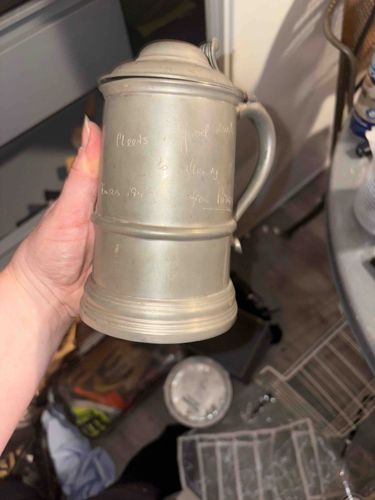
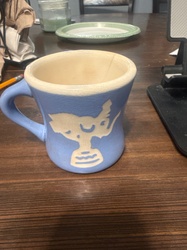
This is an antique or vintage pewter tankard, characterized by its cylindrical body and a hinged domed lid. The tankard is constructed entirely of pewter, presenting a dull, silvery-grey patina typical of aged pewterware. The surface exhibits a slightly textured, matte finish. The overall form is robust and functional, designed for drinking. The body of the tankard features a prominent horizontal band or ribbing approximately two-thirds of the way down from the rim, which adds structural definition and visual interest. Towards the base, there are several concentric rings, indicating either a stepped foot design or decorative turnings. A C-shaped handle is attached to the side, maintaining the same pewter material and finish as the rest of the vessel. The most distinguishing feature is the engraved inscription on the front body of the tankard. While partially obscured and difficult to fully decipher, visible words include 'pleads', 'good', 'day', 'December 1918', and 'from'. This suggests it may be a commemorative piece or a gift, possibly dating to the early 20th century, specifically around December 1918. The engraving appears to be hand-scribed, adding a personal touch. The lid is domed with a small thumb-lift mechanism, suggesting a traditional design used to open the lid while holding the handle. The surface shows signs of age-appropriate wear, including minor scuffs, scratches, and a generalized darkening of the metal due to oxidation, which contributes to its antique aesthetic. There are no obvious signs of major damage such as dents or repairs from the visible angles, but a thorough inspection would be needed to confirm this. The craftsmanship appears to be sturdy and utilitarian, typical of functional drinking vessels from its presumed era. The given context 'Manor 20 39 made in England' strongly indicates its origin and potential manufacturing details. If 'Manor' is a manufacturer or retailer, and '20 39' refers to a model or capacity, this would further pinpoint its provenance and age.
AI Appraisal Report
This Engraved Pewter Tankard with Domed Lid, bearing the inscription 'Manor 20 39 made in England,' presents as a genuine antique or vintage piece, likely dating to the early 20th century, specifically reinforced by the 'December 1918' engraving. The dull, silvery-grey patina, minor scuffs, scratches, and generalized oxidation are consistent with age-appropriate wear for pewterware of this period, indicating good overall condition with no apparent major damage or repairs from visual assessment. The construction appears sturdy and utilitarian, typical of functional drinking vessels from its era.
Market demand for antique pewter tankards is generally moderate. While not as sought after as silver or more intricate wares, pieces with clear provenance, interesting engravings, or manufacturer marks can command fair values. The 'made in England' mark, along with 'Manor 20 39,' points to a specific origin and potential manufacturer, which aids in its authenticity and desirability. The personalized engraving mentioning 'December 1918' adds a unique historical and sentimental value, suggesting it was a commemorative piece, which can enhance appeal to certain collectors.
Factors impacting its value include its solid craftsmanship, the legible portions of the engraving, and its overall good, un-restored condition. The primary limitation to a definitive appraisal and full authentication from images alone is the inability to conduct a tactile inspection for surface irregularities, hidden repairs, or the precise composition of the pewter alloy. An in-person examination would allow me to verify the structural integrity, confirm the hand-scribed nature of the engraving, and assess any minute details not visible in photographs. Furthermore, any provenance documentation related to the 'Manor' mark or the specific '20 39' designation could significantly clarify its manufacturing history and potentially increase its value. Without further verification, I rely on the visual cues and provided details.