These notes were written by the person who submitted this item. Appraiser.AI has not verified them, and the AI's identification and estimate may rely on them.
AI Estimated Value
Not an official valuation
$50 - $150
AI estimate as of July 10, 2025 · verify with a professional before acting
AI-Generated · Verify before acting
Everything on this page is generated by AI for informational purposes only. AI can make mistakes — the AI may misidentify items or misattribute them (artist, maker, brand, designer, origin, era). This is not an official valuation and should not be used for insurance, sale, tax, estate, legal, or lending purposes — or any decision requiring a certified appraisal. It is not an authoritative claim about any person, brand, or rights holder — do not share or rely on it as a factual statement about a third party. Always consult qualified professionals before making financial decisions.
This analysis also relies on unverified notes provided by the user, which may be incomplete or inaccurate and could affect the result.
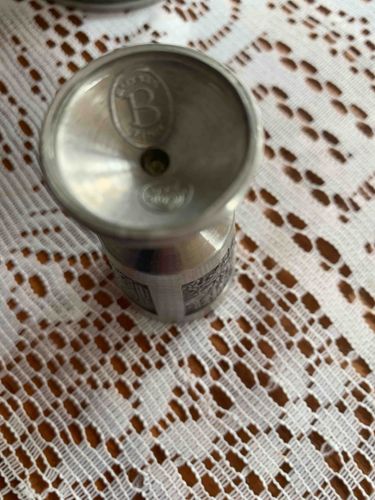
The item is a pewter goblet, characterized by its dull, silvery-grey metallic appearance and sturdy construction. The light reflects off its slightly brushed or matte surface, typical of pewter. The visible portion shows the interior base of the goblet, which is somewhat concave, leading to a small, dark circular impression or possibly a plug at its center. This central feature might be a manufacturing artifact or a design element. A significant identifying mark is prominently displayed inside the base: an oval impression with a large, embossed 'B' in the center, accompanied by what appears to be illegible text above and below the letter, likely a maker's mark or quality stamp. Another smaller, circular impression is visible near the bottom of the 'B' emblem, further hinting at manufacturing details. The overall condition appears good, with no obvious dents, cracks, or significant tarnishing, suggesting either careful use or a relatively recent production. The craftsmanship seems solid and functional for a drinking vessel. The visible portion of the exterior displays a darker, possibly etched or applied design, though it is not clear enough to discern specific patterns or images. This suggests the goblet is not plain but features external decorative elements. Based on the material and visible markings, it is likely a modern or mid-20th-century piece, as pewter alloys and marking practices have evolved over time. The design of the 'B' mark could be a key to its specific origin and age.
AI Appraisal Report
Upon examining the provided image of this pewter goblet, my initial assessment suggests a well-preserved piece. The dull, silvery-grey sheen and sturdy build are consistent with quality pewter. The interior base shows a concave form with a central impression, likely a manufacturing remnant or a design choice. The prominent oval impression containing a large 'B' with illegible text above and below is crucial. This 'B' maker's mark is the key identifier, and further research into specific pewter makers using such a mark would be essential for definitive dating and authentication. The overall condition appears good, free from obvious dents, cracks, or significant tarnishing, indicating either careful handling or relatively recent production. The craftsmanship seems solid and functional. While the exterior shows darker, possibly etched designs, I cannot discern specific patterns, limiting decorative assessment. Given the material and visible markings, this piece likely dates to the modern or mid-20th century.
Market conditions for pewter goblets can vary. Period pieces from renowned makers or those with significant historical provenance generally command higher values. Without knowing the maker definitively, it's difficult to gauge specific demand or rarity. General pewter items often have a modest market, with enthusiasts seeking specific makers or designs. The primary factor impacting value here is the unidentified 'B' maker's mark. If it corresponds to a well-known or collectible pewterer, the value would significantly increase. Factors like the specific alloy used and the overall design aesthetics also contribute to value.
My primary limitation in this appraisal is the lack of physical examination. While the image is clear, I cannot ascertain the goblet's weight, balance, or detect subtle surface imperfections, which can influence condition assessment. Full authentication would require in-person examination to verify material composition, a thorough investigation of the 'B' maker's mark against historical records of pewterers, and ideally, provenance documentation detailing its ownership history. Scientific testing, such as X-ray fluorescence (XRF) for alloy composition, could further pinpoint its age and origin. Without physical access and deeper research into the maker's mark, this appraisal assumes standard modern pewter-making practices and relies heavily on visual cues from the image.