These notes were written by the person who submitted this item. Appraiser.AI has not verified them, and the AI's identification and estimate may rely on them.
AI Estimated Value
Not an official valuation
$100 - $180
AI estimate as of August 17, 2025 · verify with a professional before acting
AI-Generated · Verify before acting
Everything on this page is generated by AI for informational purposes only. AI can make mistakes — the AI may misidentify items or misattribute them (artist, maker, brand, designer, origin, era). This is not an official valuation and should not be used for insurance, sale, tax, estate, legal, or lending purposes — or any decision requiring a certified appraisal. It is not an authoritative claim about any person, brand, or rights holder — do not share or rely on it as a factual statement about a third party. Always consult qualified professionals before making financial decisions.
This analysis also relies on unverified notes provided by the user, which may be incomplete or inaccurate and could affect the result.
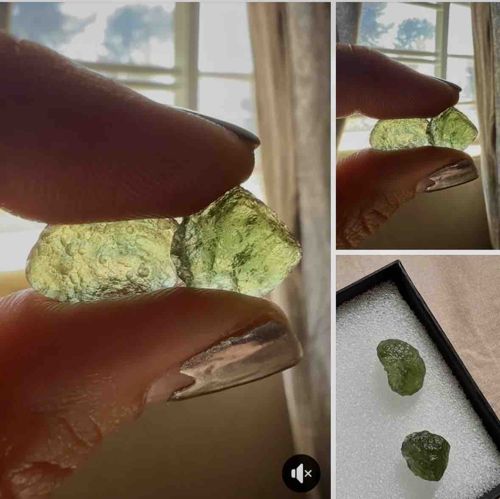
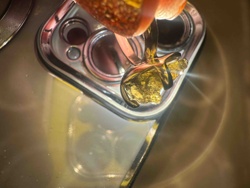
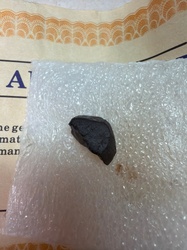
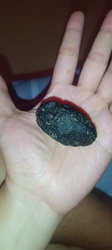
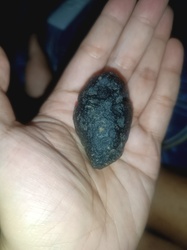
The item consists of at least two, possibly more, individual pieces of raw Moldavite, as seen in the images. Each piece is a translucent to semi-translucent green vitrified tektite, exhibiting a characteristic highly irregular and textured surface with distinct pitting, grooves, and corrugated formations. This 'sculpted' texture is typical of authentic Moldavite, formed by atmospheric ablation during its fiery descent. The color varies slightly under different lighting conditions, ranging from a lighter, almost olive-green to a richer, darker forest green. When backlit, as seen in the images where the pieces are held between fingers against natural light, their translucency becomes evident, allowing light to pass through and highlight internal characteristics such as entrapped bubbles or flow lines, although these are not clearly discernible in the provided image.
The individual pieces appear to be relatively small, likely fitting comfortably between average-sized fingers, suggesting a size suitable for collection or use in jewelry. Their organic, often tear-drop, disk, or irregular natural shapes indicate they are unpolished and unfaceted, retaining their original geological form. There are no visible signs of cutting, polishing, or modern manufacturing marks. The condition appears to be excellent for natural specimens of this type, with no apparent chips, breaks, or repairs; the 'damage' seen is a natural part of their formation. The dark box with white foam or cushioning material suggests these are being presented as valued specimens, likely for sale or private collection. Moldavite is estimated to be approximately 14.7 million years old, having formed from a meteoritic impact in present-day southern Germany.
AI Appraisal Report
Upon examining the provided images of these raw Moldavite specimens, I note several key characteristics consistent with authentic tektites from the Ries impact event. The specimens exhibit the quintessential deep, dynamic surface texturing, often described as 'sculpted,' with distinct grooves, pits, and wrinkles resulting from atmospheric ablation. The translucency revealed when backlit, showing a classic bottle-green to olive-green hue, is also a positive indicator. The overall condition appears excellent for raw, unworked specimens, with no visible signs of post-collection damage like chips or fractures.
The market for genuine Moldavite has seen a dramatic increase in demand and value, driven by its unique origin story, metaphysical appeal, and finite supply. Comparable raw specimens of this apparent quality and size (estimated at a few grams each based on the images) typically trade at a premium. Factors significantly impacting value include weight, shape, and intensity of surface texturing. The specimens shown possess desirable, highly textured surfaces.
However, this appraisal is provisional and based solely on visual analysis of images. Sophisticated fakes and imitations, often made from green glass, are prevalent. A definitive authentication requires in-person examination. Physical inspection would allow me to test for specific gravity, refractive index, and examine the specimens under magnification for characteristic inclusions like Lechatelierite (fused quartz) and a distinct 'schlieren' or flow-like texture, which are nearly impossible for forgeries to replicate. Without such tests or provenance documentation, absolute authenticity cannot be guaranteed.