AI Appraisal Estimate

AI-generated estimates · not official valuations

From the user

What was submitted

Photo and notes provided by the user — not generated by AI

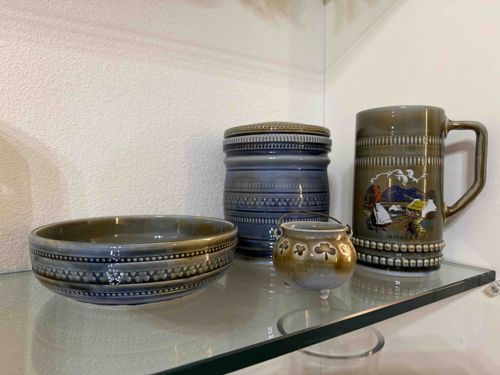
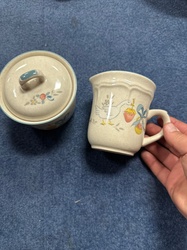
Submitted item photo
Submitted photo · June 10, 2026

User's notes

Irish porcelain Clover on bottom

AI analysis below

AI appraisal

AI analysis & estimate

AI-Generated · Verify before acting

Everything below is generated by AI for informational purposes only. AI can make mistakes — the AI may misidentify items or misattribute them (artist, maker, brand, designer, origin, era). This is not an official valuation and should not be used for insurance, sale, tax, estate, legal, or lending purposes — or any decision requiring a certified appraisal. It is not an authoritative claim about any person, brand, or rights holder — do not share or rely on it as a factual statement about a third party. Always consult qualified professionals before making financial decisions.

Note

This analysis also relies on unverified notes provided by the user, which may be incomplete or inaccurate and could affect the result.

Read the full disclaimer

AI Identification

·Not independently authenticated·Verify before acting

Carrigaline Irish Pottery Studio Assortment

Vintage Irish Ceramics and Stoneware

AI Estimated Value

·Not an official valuation·Verify before acting

$45.00 - $70.00

As of June 10, 2026

AI Item Analysis

·AI can make mistakes·Verify before acting
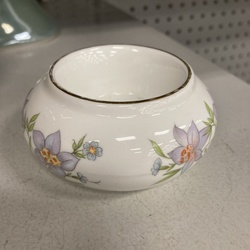
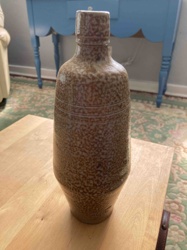
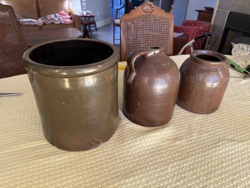
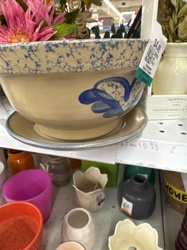
A collection of four vintage stoneware pieces likely produced by Carrigaline Pottery in Cork, Ireland. The group includes a low decorative bowl, a lidded canister, a miniature three-legged cauldron (potch), and a tall tavern mug. These items are crafted from high-density stoneware and feature the brand's signature high-sheen salt-glaze finish. The color palette is characteristic of mid-20th-century Irish souvenir ware, showcasing a gradient bleed of heather purple, deep slate blue, and moss green. Construction details include intricate slip-molded textures such as 'beaded' bands and repeated patterns of embossed geometric shapes on the bowl and mug. The tavern mug displays a transfer-printed or hand-painted vignette of an Irish country landscape, featuring a traditional thatched-roof cottage and a figure in rural dress. The miniature cauldron features embossed shamrock motifs and a wire handle. Per the user's description, the bases bear the distinctive 'Clover' or Shamrock stamp used by Irish manufacturers to verify origin. The set appears to be in excellent vintage condition with no visible cracks or significant chips, displaying only minor shelf wear consistent with display pieces from the 1960s to 1970s. The craftsmanship reflects a robust, industrial-arts style intended for both utility and as tokens of Irish heritage.
AI Appraisal Report

·AI can make mistakes·Verify before acting
I have virtually examined this four-piece assortment of Irish stoneware, attributed to the Carrigaline Pottery of County Cork. Based on the provided imagery, the items exhibit the characteristic tri-color salt-glaze—blending heather, slate, and moss tones—associated with the mid-20th-century 'Souvenir' or 'Studio' lines. The 'Clover' or Shamrock stamp on the base is a hallmark of Carrigaline’s production between the 1960s and early 1970s. The condition appears to be 'Excellent Vintage,' with the slip-molded beaded bands and relief shamrocks showing sharp definition. The tavern mug’s transfer print remains vibrant, suggesting minimal abrasive cleaning. While Carrigaline was high-output industrial pottery, this specific combination of forms—particularly the lidded canister and the miniature cauldron—adds modest value as a decorative set. Market demand for mid-century Irish souvenir ware is stable but limited primarily to collectors of Hiberniana or nostalgic home decor. Similar individual pieces typically realize $10–$20 at auction, with sets fetching slightly higher premiums due to the coordinated aesthetic. Limitations of this appraisal include the inability to physically inspect for 'hairline' cracks or micro-crazing not visible in photographs. To fully authenticate these pieces and verify they are not contemporary reproductions or from the later 1980s closure period, an in-person tactile inspection of the clay body's vitrification and a microscopic examination of the stamp's imprint depth would be required. Provenance documentation, such as original purchase receipts from Ireland, would further solidify historical value.

Get your items appraised

Instant estimates of your treasures with AI-powered appraisals

Browse More Appraisals