Glazed Hand-Painted Ceremonial Stoneware Fragment
Antique Ceramics and Pottery

Glazed Hand-Painted Ceremonial Stoneware Fragment

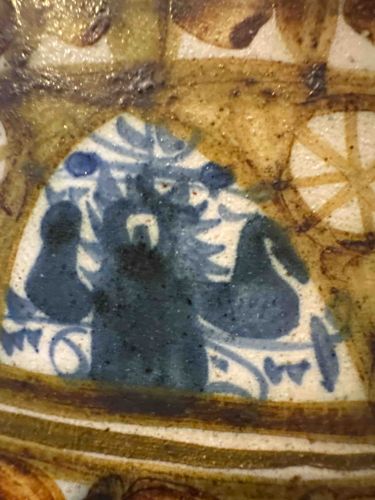
This item is a detailed fragment of a larger stoneware ceramic vessel or tile, likely dating from the 17th to 19th century based on the glazing and pigment application. The piece features a coarse-grained stoneware body visible beneath a thick, lustrous glaze. The central motif is a hand-painted cobalt blue heraldic or mythological figure, possibly a stylized double-headed eagle or a crest, set within a white slip reserve. The surrounding areas show earthy ochre, amber, and olive-green tones applied in broad strokes, suggesting a rustic yet deliberate decorative program. There are visible speckles of iron manganese and kiln debris throughout the glaze, which are hallmarks of historical wood-fired production. Notable condition issues include heavy surface crazing (the fine network of cracks in the glaze), pitting from the firing process, and significant surface wear consistent with age. There is a darkened area of abrasion or soot staining at the center of the blue figure. The brushwork exhibits a fluid, folk-art quality indicating handcrafted production rather than mass-manufactured uniformity. Overall, the piece demonstrates high-temperature firing techniques and is characteristic of European folk pottery or potentially certain styles of Latin American colonial ceramics.
Estimated Value

$450 - $650

Basic Information

Category

Antique Ceramics and Pottery

Appraised On

January 24, 2026

Estimated Value

$450 - $650

Item Description

This item is a detailed fragment of a larger stoneware ceramic vessel or tile, likely dating from the 17th to 19th century based on the glazing and pigment application. The piece features a coarse-grained stoneware body visible beneath a thick, lustrous glaze. The central motif is a hand-painted cobalt blue heraldic or mythological figure, possibly a stylized double-headed eagle or a crest, set within a white slip reserve. The surrounding areas show earthy ochre, amber, and olive-green tones applied in broad strokes, suggesting a rustic yet deliberate decorative program. There are visible speckles of iron manganese and kiln debris throughout the glaze, which are hallmarks of historical wood-fired production. Notable condition issues include heavy surface crazing (the fine network of cracks in the glaze), pitting from the firing process, and significant surface wear consistent with age. There is a darkened area of abrasion or soot staining at the center of the blue figure. The brushwork exhibits a fluid, folk-art quality indicating handcrafted production rather than mass-manufactured uniformity. Overall, the piece demonstrates high-temperature firing techniques and is characteristic of European folk pottery or potentially certain styles of Latin American colonial ceramics.
Get Your Items Appraised

Instant estimates of your treasures with AI-powered instant appraisals

Browse More Appraisals