These notes were written by the person who submitted this item. Appraiser.AI has not verified them, and the AI's identification and estimate may rely on them.
AI Estimated Value
Not an official valuation
$150-250
AI estimate as of August 2, 2025 · verify with a professional before acting
AI-Generated · Verify before acting
Everything on this page is generated by AI for informational purposes only. AI can make mistakes — the AI may misidentify items or misattribute them (artist, maker, brand, designer, origin, era). This is not an official valuation and should not be used for insurance, sale, tax, estate, legal, or lending purposes — or any decision requiring a certified appraisal. It is not an authoritative claim about any person, brand, or rights holder — do not share or rely on it as a factual statement about a third party. Always consult qualified professionals before making financial decisions.
This analysis also relies on unverified notes provided by the user, which may be incomplete or inaccurate and could affect the result.
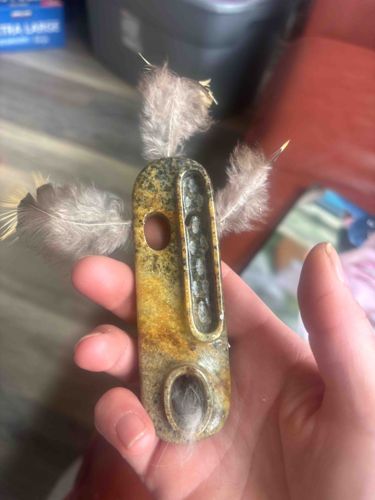
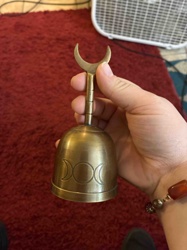
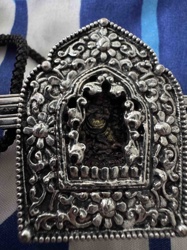
This appears to be a hand-carved soapstone ritual or decorative object, possibly resembling a stylized bird or figure, adorned with natural feathers. The primary material is a variegated soapstone exhibiting earthy tones, ranging from a pale greenish-gray to warmer ochre and brownish hues, with visible natural veining and inclusions, indicating the stone's organic origin and natural patterns. The surface of the stone appears to have a matte to slightly polished finish, characteristic of soapstone which is relatively soft and carves easily.
The object is elongated and somewhat rectangular with rounded ends, featuring two open, carved-out sections. The upper section is a circular hole, while the lower section is an elongated oval cavity, both of which appear to pass through the object. A notable feature is a longitudinal groove or channel carved into one flat side of the object, extending from near the top to the bottom. Within this channel, a series of small, irregular pebbles or possibly seeds, embedded in a clear resin or adhesive, are visible, adding textural and visual interest.
The most striking features are the natural feathers attached to various points of the object. Several soft, downy feathers, primarily in shades of light brown, gray, and white, are affixed to the top and sides, giving the impression of wings or plumage. Some feathers show slight fraying and typical wear consistent with natural materials.
The craftsmanship suggests hand-carving, given the organic shapes and slight irregularities. The visible wear and the integration of natural elements indicate it could be a contemporary folk art piece, a modern spiritual/ritualistic item, or an item created in a style perhaps reflective of indigenous art, though without further context, a precise cultural origin or age is hard to determine. The visible dirt or residue within the carved areas and around the feather attachments suggests some age or use. There are no discernible maker's marks or signatures visible in the image. The overall quality is good for a hand-carved item, with attention paid to the integration of different materials.
AI Appraisal Report
Upon my virtual examination of this carved soapstone object with feathers and stone inlay, I assess its condition as good, showing appropriate wear for a handcrafted item incorporating natural elements. The soapstone exhibits natural veining and a matte finish, with no apparent significant chips or cracks. The feathers demonstrate slight fraying, consistent with natural materials and potential age or use. Authenticity, based solely on the image, appears strong for a folk art or decorative piece. The craftsmanship suggests hand-carving due to organic shapes and slight irregularities.
Market conditions for such contemporary folk art or spiritual objects vary. Comparable items, often found in artisan markets or galleries specializing in unique handcrafted pieces, typically range from modest prices for simple examples to higher values for more intricate or uniquely designed works. Demand is niche, appealing to collectors of ethnic-inspired art, handmade decor, or unique ritualistic items. Rarity is difficult to ascertain without knowing the artisan or production volume; however, its individualistic nature makes it unique, if not inherently rare.
Factors significantly impacting value include its artistic merit, the quality of craftsmanship, and the integration of diverse materials. Should this piece be linked to a known artist, or possess demonstrable cultural or ritualistic significance, its value would markedly increase. Without such information, it remains largely a decorative art object.
Limitations in authenticity verification from images alone are significant. I cannot definitively ascertain the age, precise material composition of the embedded pebbles/seeds, or the exact method of feather attachment. Full authentication would require in-person examination to assess the tactile quality of the soapstone, confirm adhesive types, identify feather species, and thoroughly inspect for any hidden signatures or makers' marks. Provenance documentation, detailing its origins and history, would be crucial for establishing cultural context and potential ritualistic use.