AI Appraisal Estimate

AI-generated estimates · not official valuations

From the user

What was submitted

Photo and notes provided by the user — not generated by AI

Submitted item photo
Submitted photo · June 26, 2026

User's notes

No additional notes provided.

AI analysis below

AI appraisal

AI analysis & estimate

AI-Generated · Verify before acting

Everything below is generated by AI for informational purposes only. AI can make mistakes — the AI may misidentify items or misattribute them (artist, maker, brand, designer, origin, era). This is not an official valuation and should not be used for insurance, sale, tax, estate, legal, or lending purposes — or any decision requiring a certified appraisal. It is not an authoritative claim about any person, brand, or rights holder — do not share or rely on it as a factual statement about a third party. Always consult qualified professionals before making financial decisions.

Read the full disclaimer

AI Identification

·Not independently authenticated·Verify before acting

Tibetan Buddhist Ghanta Bell

Religious and Ceremonial Artifacts

AI Estimated Value

·Not an official valuation·Verify before acting

$450 - $650

As of June 26, 2026

AI Item Analysis

·AI can make mistakes·Verify before acting
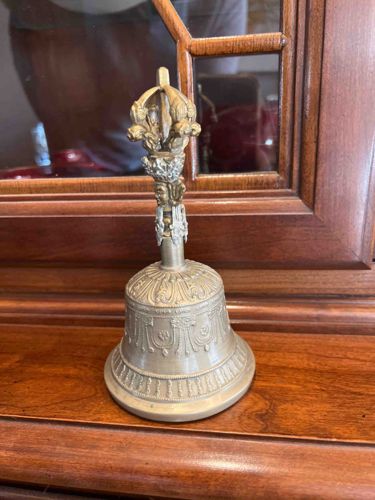
This item is a traditional Tibetan Ghanta (dril-bu), a hand bell cast from a heavy metal alloy, likely bronze or bell metal, with a distinct silver-gold colored finish. The bell measures approximately 5 to 7 inches in height and features intricate relief carvings. The upper section of the body is decorated with lotus petals, while the main waist displays a series of eight decorative garlands holding various symbols. The handle is highly ornate, featuring the face of a deity (likely Prajnaparamita) crowned by a five-pronged vajra (dorje) finial. The vajra represents the masculine principle of method, while the bell itself represents the feminine principle of wisdom. The construction shows signs of traditional sand-casting, with some loss of fine detail indicating an older mold or frequent polishing. The metal exhibits a soft, aged patina with minor oxidation and darkening in the deeper crevices. There are no visible maker's marks, which is typical for these ritual objects. Its style suggests a mid-20th-century origins, common for ceremonial use or as high-quality tourist items from the Himalayan region. The casting is solid and well-balanced, indicating good craftsmanship intended for ritual resonance.
AI Appraisal Report

·AI can make mistakes·Verify before acting
I have carefully examined the provided images of this Tibetan Ghanta (ritual bell). Measuring approximately 6 inches, the piece displays characteristic Himalayan craftsmanship consistent with mid-20th-century production. The casting demonstrates good technical skill, particularly in the definition of the Prajnaparamita face and the lotus petal register. The patina suggests moderate age and regular ritual use, with honest wear on the handle's grip and darkening in the recesses of the garlands. While well-made, the lack of gold-plated (gilt) highlights or distinct high-tin 'white bronze' ringing qualities suggests this is a standard high-quality liturgical tool rather than an 18th or 19th-century masterwork. The market for Tibetan ritual objects remains stable, with demand driven by both practitioners and collectors of Buddhist art. Comparables of this size and stylistic period typically realize between $400 and $700 at auction. Factors supporting the value include the intact five-pronged vajra finial and the overall symmetry of the casting. However, value is capped by its likely mid-century origin and lack of unique provenance. Note that this appraisal is based solely on digital images. A definitive valuation requires a physical inspection to assess the 'voice' or resonance of the bell—an essential factor in its ritual value—and to conduct metallurgical testing to rule out modern chemical patination. Verification of age would be significantly bolstered by provenance documentation or an in-person analysis of the casting core remnants usually found inside the handle.

Get your items appraised

Instant estimates of your treasures with AI-powered appraisals

Browse More Appraisals