AI estimate as of November 9, 2025 · verify with a professional before acting
AI-Generated · Verify before acting
Everything on this page is generated by AI for informational purposes only. AI can make mistakes — the AI may misidentify items or misattribute them (artist, maker, brand, designer, origin, era). This is not an official valuation and should not be used for insurance, sale, tax, estate, legal, or lending purposes — or any decision requiring a certified appraisal. It is not an authoritative claim about any person, brand, or rights holder — do not share or rely on it as a factual statement about a third party. Always consult qualified professionals before making financial decisions.
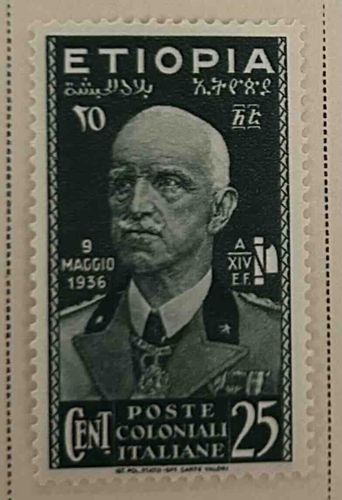
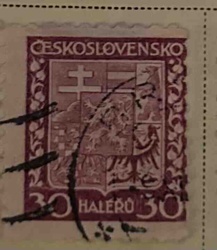
This item is a postage stamp, likely from the period of Italian occupation of Ethiopia. The stamp features a central portrait of a bald, older man with a mustache, depicted in military uniform with medals and insignia. The predominant colors are dark green/teal for the main design elements and a lighter, off-white or cream for the background of the image and the perforated borders. The stamp is rectangular in shape with serrated, perforated edges, indicating it was part of a sheet.
Key inscriptions on the stamp include 'ETIOPIA' at the top, along with its transliteration in Amharic script (Ethiopian language) and Arabic script, 'بلاد الحبشة'. To the left of the portrait, '9 MAGGIO 1936' is visible, marking a specific date. To the right, 'A. XIV E.F.' is inscribed, which likely refers to the 14th year of the Fascist Era (Anno Fascista), aligning with the 1936 date. The denomination '25 CENT' is prominently displayed at the bottom, with 'POSTE COLONIALI ITALIANE' written below it, clearly identifying its origin and use. The numeral '25' is also large on the bottom right. The overall condition appears to be relatively good, with no obvious major tears or creases, although some slight discoloration or paper aging may be present. The printing quality indicates a well-executed engraving or lithographic process, characteristic of government-issued postage stamps from that era. The perforation seems intact. This stamp represents a specific historical period and colonial administration, making it of interest to philatelists and historians.
AI Appraisal Report
I have examined the provided image of the Ethiopia Italian Occupation 25 Centesimi postage stamp. Visually, the stamp appears to be authentic for the period, featuring Victor Emmanuel III, issued to commemorate the Italian annexation of Ethiopia on May 9, 1936 (A.XIV E.F.). The inscriptions 'ETIOPIA', Amharic text, 'بلاد الحبشة', '9 MAGGIO 1936', 'A. XIV E.F.', and 'POSTE COLONIALI ITALIANE' with the '25 CENT' denomination are consistent with known examples of this issue.
The condition, based on the image, appears to be 'Fine-Very Fine'. The perforations seem intact and well-separated from a sheet. There are no obvious major tears, creases, or significant thins visible. The centering looks reasonable, and the image quality suggests a well-executed impression. There might be some minor toning or age-related discoloration, which is typical for stamps of this era and does not significantly detract from its value unless severe.
In terms of market conditions, this stamp, Scott #C17 (or similar catalog numbers depending on the specific catalog utilized), is relatively common for the series. While it represents a specific historical period, the demand is moderate rather than high. Rarity is low as these were widely distributed. Comparable sales for well-preserved, unused examples without major flaws typically fall within a modest range. Factors impacting value significantly would be original gum (if unused), perfect centering, and absence of handling marks, hinge remnants, or any other damage. Due to examining only an image, I cannot definitively verify the presence or condition of the gum, nor can I fully assess for minor imperceptible flaws, paper thinning, repairs, or re-gumming. For full authentication and a more precise valuation, I would require a physical, in-person examination, ideally accompanied by high-resolution imaging and, if provenance is available, documentation of its history.