These notes were written by the person who submitted this item. Appraiser.AI has not verified them, and the AI's identification and estimate may rely on them.
AI Estimated Value
Not an official valuation
$50-150
AI estimate as of September 19, 2025 · verify with a professional before acting
AI-Generated · Verify before acting
Everything on this page is generated by AI for informational purposes only. AI can make mistakes — the AI may misidentify items or misattribute them (artist, maker, brand, designer, origin, era). This is not an official valuation and should not be used for insurance, sale, tax, estate, legal, or lending purposes — or any decision requiring a certified appraisal. It is not an authoritative claim about any person, brand, or rights holder — do not share or rely on it as a factual statement about a third party. Always consult qualified professionals before making financial decisions.
This analysis also relies on unverified notes provided by the user, which may be incomplete or inaccurate and could affect the result.
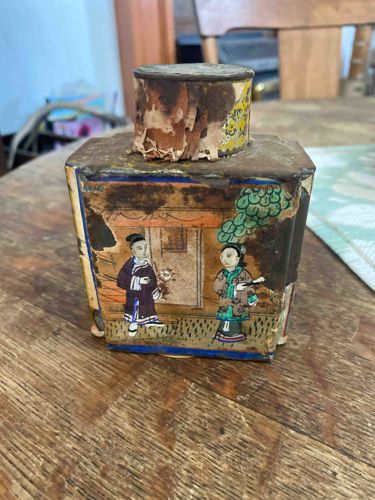
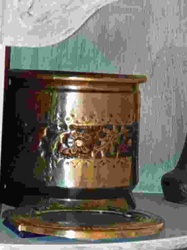
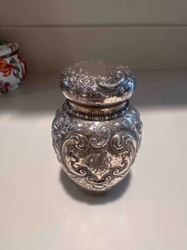
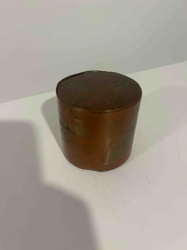
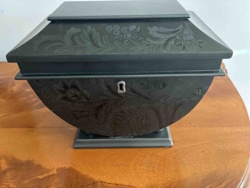
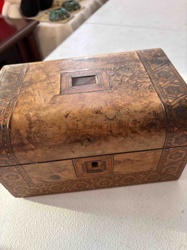
This item is an antique Chinese decorated tea caddy, likely constructed from a thin metal, possibly tin, given its hexagonal or octagonal shape and cylindrical neck. The caddy features richly decorated paper or painted panels on its sides, depicting traditional Chinese figures and architectural elements. On the visible side, two figures, one male in a dark robe and another female in a green and brown patterned garment, are shown standing in front of a building or doorway. A stylized green tree or bush element is also visible on the right side of the panel. The colors used include blue, green, orange, brown, and black. The item exhibits significant wear and tear consistent with considerable age and use. The decorative paper or paint is extensively chipped, torn, and discolored, revealing the underlying metal. The cylindrical neck, which would have had a lid (now missing or heavily deteriorated), is severely corroded and the decorative covering is almost completely peeled away, showing evidence of flaking material and rust. The top surface of the caddy also shows heavy wear, discoloration, and what appears to be a protective coating or lacquer that has darkened and cracked over time. The edges and corners are worn, and there are visible signs of oxidation on the metal components. The overall condition suggests a very old piece, possibly dating back to the late 19th or early 20th century, reflecting a folk art or utilitarian craftsmanship style for storing tea or other dry goods. The intricate, hand-painted or printed decorative panels, despite their degraded condition, suggest attention to detail in its original production.
AI Appraisal Report
Upon examining the provided image of this antique Chinese decorated tea caddy, it is clear this is a utilitarian item, likely constructed from tin, consistent with its hexagonal or octagonal form and cylindrical neck. The decorative panels, depicting traditional Chinese figures and architecture, appear to be either paper-based or hand-painted. The color palette of blue, green, orange, brown, and black is typical of such pieces. The item exhibits significant wear, with extensive chipping, tearing, and discoloration of the decorative surface, revealing the underlying metal. The cylindrical neck shows severe corrosion, flaking material, and rust, indicating the original lid is absent or deteriorated. The overall condition, including wear on edges and corners, and oxidation, strongly suggests a very old piece, likely late 19th to early 20th century. This aligns with the owner's description of it being 'very old.'
Authenticity: While the style and condition are consistent with an antique Chinese tea caddy of that period, a definitive authenticity verification is limited by image-only examination. An in-person inspection would allow me to assess the material (confirming tin vs. other metals), the application technique of the decoration (confirming paper or paint), and the extent of the corrosion and metal fatigue. I would also look for any maker's marks or stamps. Provenance documentation, though unlikely for such a utilitarian item, would also be beneficial.
Market Conditions & Comparables: The market for utilitarian Chinese folk art, especially in heavily degraded condition, is modest. Similar items, even in better condition, typically fetch prices in the low hundreds. The current condition, with significant material loss and corrosion, severely impacts its aesthetic and collectible value. Without the lid, it is also incomplete.
Demand & Rarity: While antique Chinese items generally have collector interest, the demand for common utilitarian pieces in poor condition is low. It's not rare as a type, but its specific decorative elements might be unique. The severe condition makes it more of a historical curiosity than a high-value collectible.
Factors Impacting Value: The primary factors impacting value are its poor condition, the missing lid, and the extensive degradation of the decorative elements. The material (likely tin) is not inherently valuable. Its age is a positive, but overshadowed by its condition. The limited aesthetic appeal due to wear significantly reduces its market desirability.
Considering these factors, I would place the appraisal value between $50 and $150.