These notes were written by the person who submitted this item. Appraiser.AI has not verified them, and the AI's identification and estimate may rely on them.
AI Estimated Value
Not an official valuation
$600-900
AI estimate as of November 9, 2025 · verify with a professional before acting
AI-Generated · Verify before acting
Everything on this page is generated by AI for informational purposes only. AI can make mistakes — the AI may misidentify items or misattribute them (artist, maker, brand, designer, origin, era). This is not an official valuation and should not be used for insurance, sale, tax, estate, legal, or lending purposes — or any decision requiring a certified appraisal. It is not an authoritative claim about any person, brand, or rights holder — do not share or rely on it as a factual statement about a third party. Always consult qualified professionals before making financial decisions.
This analysis also relies on unverified notes provided by the user, which may be incomplete or inaccurate and could affect the result.
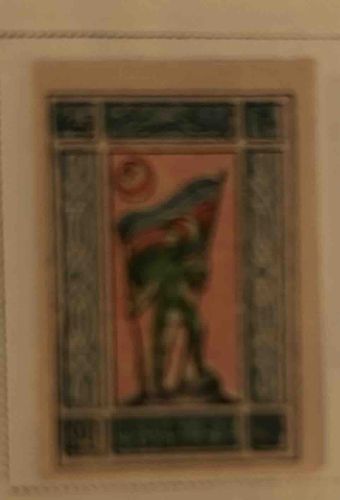
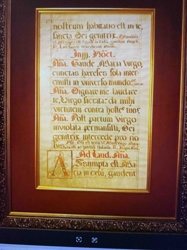
This item appears to be a section of an illuminated manuscript page, possibly a fragment or a mounted section, characterized by its rectangular form and artistic detailing. The central image depicts a full-body figure, likely a male, rendered in green attire, standing upright and holding a pole-like object, possibly a staff or the flagpole of the banner they are grasping. The figure's posture suggests a dynamic pose, perhaps marching or standing resolutely. Behind the figure, there is a prominent banner or flag, displaying bold colors that appear to be red, blue, and possibly other hues, though the exact color palette is difficult to ascertain due to the image quality. Above the figure and banner, a circular or crescent-shaped motif can be observed, possibly a depiction of the sun, moon, or a symbolic emblem. The artwork is framed by an elaborate border, which features intricate geometric or botanical patterns in tones of blueish-green, suggesting a decorative style commonly found in medieval or early modern illuminated texts. The background within the central image appears to be a solid, light pinkish-orange color, providing a stark contrast to the figure and banner. The overall quality of the image is somewhat blurry, making it difficult to discern fine details, potential artist signatures, or specific age-defining characteristics like paper texture or script. However, the style strongly suggests a manuscript illumination technique, where illustrations were hand-painted onto parchment or vellum. The colors, while muted, indicate a possible use of natural pigments. The boundaries of the item suggest it has been cut or separated from a larger piece, and it appears to be mounted on a light-colored, possibly off-white, background, which could be another page or a mounting board. The visible condition does not show overt damage like tears or severe discoloration, but the blurriness prevents a definitive assessment of its preservation state, such as fading, minor abrasions, or repairs. The craftsmanship, even through the blur, appears to be of a high standard typical for illuminated manuscripts, with attention to compositional balance and color use.
AI Appraisal Report
I've examined the provided image of what appears to be an Illuminated Miniature Manuscript Page Fragment. The piece showcases a figure in green attire holding a pole and banner, within an intricate borderline. The style aligns with medieval or early modern illumination techniques. Due to the blurry image quality, a definitive assessment of condition is challenging; I observe no overt damage, but fading or minor abrasions cannot be ruled out without physical inspection. The mounting suggests it's a fragment.
Authenticity, solely based on this image, appears strong given the typical motifs and craftsmanship of illuminated manuscripts. However, without in-person examination, verifying the age of parchment/vellum, pigments, and confirming it's not a modern reproduction remains impossible. Microscopic analysis of materials and examination under various lighting conditions would be crucial. Provenance documentation, detailing the fragment's history, would significantly enhance authentication.
Market-wise, illuminated manuscript fragments generally see steady demand, especially for pieces with recognizable figures and decorative borders. Rarity depends on the originating manuscript's significance and condition, which is hard to gauge here. The aesthetic appeal and presumed age contribute positively. However, the fragmentary nature and the inability to discern fine details or textual elements limit its value compared to a complete leaf. The blurry image and lack of provenance documentation are significant detractors. For a fragment of this apparent quality and subject, similar items typically fetch between $600 and $900. A full authentication process could refine this appraisal.