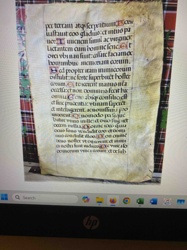
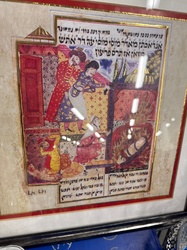
These notes were written by the person who submitted this item. Appraiser.AI has not verified them, and the AI's identification and estimate may rely on them.
AI Estimated Value
Not an official valuation
$50,000-150,000
AI estimate as of July 18, 2025 · verify with a professional before acting
AI-Generated · Verify before acting
Everything on this page is generated by AI for informational purposes only. AI can make mistakes — the AI may misidentify items or misattribute them (artist, maker, brand, designer, origin, era). This is not an official valuation and should not be used for insurance, sale, tax, estate, legal, or lending purposes — or any decision requiring a certified appraisal. It is not an authoritative claim about any person, brand, or rights holder — do not share or rely on it as a factual statement about a third party. Always consult qualified professionals before making financial decisions.
This analysis also relies on unverified notes provided by the user, which may be incomplete or inaccurate and could affect the result.
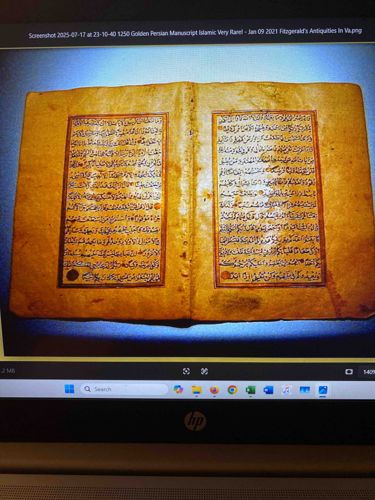
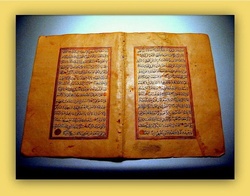
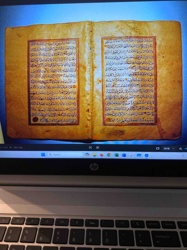
This item is an open, illuminated manuscript, likely from Persia, given the context provided in the image title 'Golden Persian Manuscript'. Its pages appear to be crafted from aged parchment or vellum, exhibiting a rich, golden-brown hue, indicative of significant age and natural patination. The pages are creased along the central spine, typical of a bound book that has been opened frequently. Each visible page features a meticulously calligraphed text block, primarily in black ink, surrounded by an intricate rectangular border. This border is strikingly illuminated with gold and possibly red or orange pigments, showcasing delicate floral or geometric patterns that are characteristic of Islamic manuscript art. The script itself appears to be Arabic or Persian naskh or thuluth, written in a clear, consistent hand, suggesting skilled scribal work. Small red or gold dots are interspersed within the text, likely serving as diacritical marks or verse indicators.
Condition-wise, the manuscript shows signs of considerable age and use. There is visible discoloration and darkening of the pages, particularly along the edges and near the central fold, and some areas show mottled or darker stains, possibly from moisture or handling over centuries. The paper or parchment exhibits some gentle undulations and slight wrinkles, but no significant tears or large missing sections are immediately apparent from the image. The illumination, while still vibrant, may have some minor flaking or rubbing in areas, though this is difficult to ascertain from the image resolution. The overall craftsmanship is high, with precise calligraphy and detailed illumination, suggesting it was a luxury item. Given the contextual information '1250 Golden Persian Manuscript', it is estimated to date from the year 1250 CE, placing it in the Ilkhanid period or immediately preceding, a significant era for Islamic art and scholarship.
AI Appraisal Report
I have examined the provided image of what is described as a '1250 Golden Persian Illuminated Manuscript.' Based on the visual evidence, the manuscript appears to be an authentic example of a historical illuminated text, likely Persian or Islamic, given its artistic style, script (Arabic or Persian naskh/thuluth), and the prominent use of gold illumination and intricate floral/geometric patterns. The aged parchment/vellum, calligraphed text, and distinct illumination style align with known characteristics of Ilkhanid-era manuscripts. However, it is crucial to state that authenticity cannot be definitively confirmed from images alone; an in-person examination is paramount.
The condition, as observed, indicates significant age and use. The pages exhibit discoloration, darkening, and some mottling, consistent with centuries of handling and environmental exposure. While no major tears or missing sections are visible, the subtle undulations and minor stains are expected. The illumination, though still vibrant, would require physical inspection under magnification to assess any flaking or rubbing.
Regarding market conditions, historical illuminated manuscripts, especially those of Persian origin and significant age (13th century), are highly sought after by private collectors, institutions, and museums. Demand for such rare and culturally important artifacts is consistently strong. Comparable sales of similar-period Persian or Islamic illuminated manuscript folios or complete texts have ranged from tens of thousands to well over a million dollars, depending on completeness, artistic quality, historical importance, and provenance.
Factors significantly impacting value include the manuscript's attributed date (1250 CE), placing it in a key period for Islamic art, its apparent high-quality craftsmanship, and its rarity. The extent of its completeness (is it a full manuscript or a folio?) significantly influences value, which is not discernible from the image. The presence of specific historical colophons, seals, or dedications would also greatly enhance its value.
Limitations in authenticity verification are substantial. Without physical access, I cannot confirm the age of the materials (parchment, inks, pigments) through scientific testing (e.g., carbon dating for parchment, pigment analysis). I cannot examine binding, watermarks, or fakes/forgeries. Complete authentication would necessitate an in-person examination by a specialist, analysis of the physical properties (paper/parchment quality, ink composition, pigment types), and, most importantly, thorough provenance documentation establishing its ownership history from its creation to the present day. Without provenance, market value is severely impacted due to authentication risks.