AI estimate as of September 6, 2025 · verify with a professional before acting
AI-Generated · Verify before acting
Everything on this page is generated by AI for informational purposes only. AI can make mistakes — the AI may misidentify items or misattribute them (artist, maker, brand, designer, origin, era). This is not an official valuation and should not be used for insurance, sale, tax, estate, legal, or lending purposes — or any decision requiring a certified appraisal. It is not an authoritative claim about any person, brand, or rights holder — do not share or rely on it as a factual statement about a third party. Always consult qualified professionals before making financial decisions.
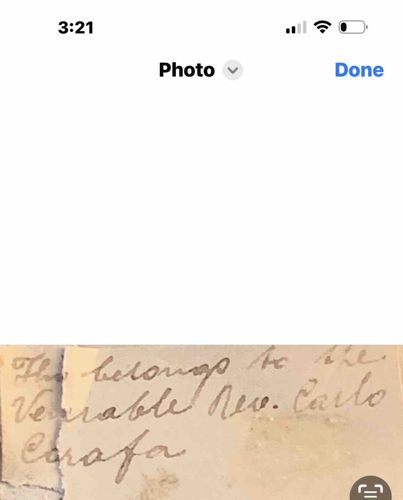
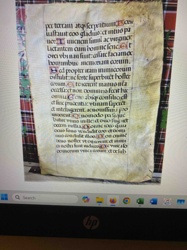
This item is a fragment of what appears to be an aged, handwritten inscription on paper or parchment. The visible portion of the inscription reads: 'This belongs to the Venerable Rev. Carlo Carafa'. The handwriting is a cursive script, likely executed with ink, and exhibits characteristics consistent with an older style of penmanship, though a precise date cannot be determined from this fragment alone. The color of the material suggests an off-white or cream hue, typical of aged paper, with some visible discoloration and possible foxing or staining, indicated by darker, irregular marks within the legible text area. The edges of the fragment appear torn or irregularly cut, rather than precisely trimmed, suggesting it was once part of a larger document or item. The overall condition shows signs of significant age and handling, including creasing and possibly some surface abrasion, which has slightly faded parts of the ink. The quality of the penmanship appears consistent and deliberate, indicating a skilled hand. Given the content, it likely served as an ownership inscription or a dedication for a book, manuscript, or another type of religious artifact.
AI Appraisal Report
Based on my visual examination of the provided image, this handwritten inscription fragment, bearing the text 'This belongs to the Venerable Rev. Carlo Carafa', appears to be an authentic piece of aged paper or parchment. The cursive handwriting aligns with historical penmanship styles, and the discoloration, foxing, and torn edges are consistent with significant age and natural wear. The off-white/cream hue further supports its antiquity. The quality of the penmanship suggests a skilled hand.
Market conditions for such fragments depend heavily on the historical significance of the named individual and the context from which the fragment originated. While 'Carlo Carafa' is a notable name, particularly within ecclesiastical history (e.g., Cardinal Carlo Carafa), without the original document, book, or artifact, its direct historical connection and therefore its value are limited. Comparables would include other standalone historical inscription fragments or ephemera, which typically fetch modest prices unless directly linked to a major historical figure or event. Demand for such uncontextualized fragments is niche; collectors often prefer complete documents or items with clear provenance. Rarity is difficult to assess without knowing how many such fragments exist.
Factors significantly impacting value include the lack of the complete item it originated from and the absence of any provenance documentation. While the name 'Carlo Carafa' is recognizable, without definitive proof that this fragment belonged to a significant figure like Cardinal Carlo Carafa, its appeal is primarily as an interesting piece of antique handwriting.
It is crucial to note that this assessment is based solely on the image. For full authentication, physical inspection would be essential to verify the paper/parchment type, ink composition, and exact age through scientific testing (e.g., carbon dating, ink analysis). In-person examination would also allow for a more thorough assessment of the texture, weight, and overall condition. Provenance documentation, such as records of its previous ownership or the item it was removed from, would be paramount for maximizing its value and confirming its historical context.