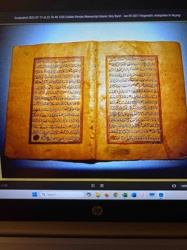
Circa 1250 Golden Persian Manuscript. 1 double sheet.
These notes were written by the person who submitted this item. Appraiser.AI has not verified them, and the AI's identification and estimate may rely on them.
AI Estimated Value
Not an official valuation
$10,000-15,000
AI estimate as of July 18, 2025 · verify with a professional before acting
AI-Generated · Verify before acting
Everything on this page is generated by AI for informational purposes only. AI can make mistakes — the AI may misidentify items or misattribute them (artist, maker, brand, designer, origin, era). This is not an official valuation and should not be used for insurance, sale, tax, estate, legal, or lending purposes — or any decision requiring a certified appraisal. It is not an authoritative claim about any person, brand, or rights holder — do not share or rely on it as a factual statement about a third party. Always consult qualified professionals before making financial decisions.
This analysis also relies on unverified notes provided by the user, which may be incomplete or inaccurate and could affect the result.
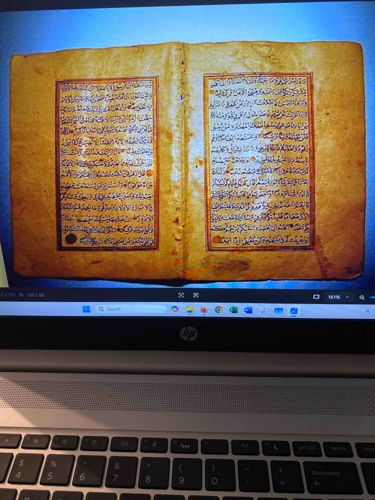
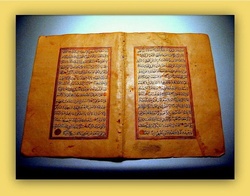
This item is identified as a double sheet from a Golden Persian Manuscript, circa 1250. The physical characteristics indicate a page likely made from vellum or high-quality paper, given its thickness and the visible texture, showing a rich, yellowish-tan hue, suggesting the 'golden' aspect of the manuscript's description. The sheet is unfolded, presenting two distinct illuminated text blocks. Each text block is framed by an ornate border composed of thin, parallel lines in red and dark brown or black, creating a refined enclosure for the calligraphy. The text itself is densely packed, written in a clear, dark script, likely Persian or Arabic, with some words or phrases highlighted in red ink, possibly indicating chapter headings, significant verses, or rubrication.
Observable features include finely executed calligraphy, demonstrating a high level of penmanship. There are small, circular or dot-like gold accents interspersed within the text, particularly at the end of verses or sections, adding to the 'golden' designation. These accents vary in size and prominence, some appearing as solid gold dots, others as outlined circles.
Regarding condition, the sheet exhibits significant signs of age and wear. There is noticeable discoloration, appearing as darker mottling and stains across the surface, especially evident in the centerfold where the two pages meet. Creases and folds are apparent, particularly along the spine where the sheet would have been bound into a codex. Small tears or chips might be present along the edges, though not clearly visible from this image resolution. The overall appearance suggests a well-preserved but undoubtedly ancient artifact, with a beautiful patina that speaks to its age. The craftsmanship is evident in the precise ruling for the text blocks and the consistent calligraphic hand. No explicit maker's marks or signatures are discernible in the provided image.
AI Appraisal Report
Based on my visual examination of the provided image and the owner's description, I have appraised this double sheet from a Golden Persian Manuscript, circa 1250. The item exhibits finely executed calligraphy and the distinct 'golden' accents, indicative of its described origin and period. The physical characteristics, including parchment-like texture and rich hue, align with early manuscript production.
In terms of condition, the sheet shows significant age-appropriate wear, including discoloration, mottling, and creasing, particularly at the centerfold. While these imperfections are noteworthy, they are typical for an artifact of this extreme age and do not detract significantly from its historical and aesthetic value, instead contributing to its patina. The craftsmanship, evident in the precise ruling and consistent hand, is of high quality for the period.
Market conditions for illuminated manuscript leaves, especially from the Islamic world and of this antiquity, are robust. Comparables typically include single or double leaves from Persian, Arabic, or Ottoman manuscripts of similar age and quality. Demand for such rare and historically significant items is consistently strong among private collectors and institutional buyers. The rarity of an authentic 13th-century double sheet, particularly one described as 'golden,' enhances its value.
However, it's crucial to state the limitations of an appraisal based solely on images. While the visual evidence strongly suggests authenticity, a definitive verification requires in-person examination. This would allow for a tactile assessment of the material (vellum vs. paper), closer inspection of the pigments and gold application, and detailed analysis of the script. Furthermore, provenance documentation (ownership history) is paramount for full authentication and can significantly impact value. Scientific testing, such as radiocarbon dating of the material or pigment analysis, could provide irrefutable proof of age and composition, which is not possible from imagery alone. Without these, I must factor in a degree of uncertainty regarding absolute authenticity.