AI estimate as of November 10, 2025 · verify with a professional before acting
AI-Generated · Verify before acting
Everything on this page is generated by AI for informational purposes only. AI can make mistakes — the AI may misidentify items or misattribute them (artist, maker, brand, designer, origin, era). This is not an official valuation and should not be used for insurance, sale, tax, estate, legal, or lending purposes — or any decision requiring a certified appraisal. It is not an authoritative claim about any person, brand, or rights holder — do not share or rely on it as a factual statement about a third party. Always consult qualified professionals before making financial decisions.
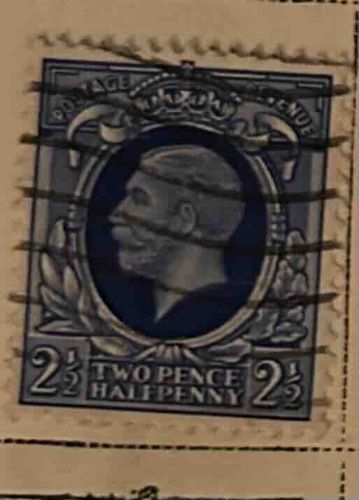
This item is a definitive postage stamp depicting King George V. The stamp is predominantly blue and features a profile portrait of King George V facing left, enclosed within an oval frame. Above the portrait, a crown and decorative filigree are visible. The words "POSTAGE" and "REVENUE" are inscribed on a banner curling over the crown, situated at the top left and top right, respectively. The denomination "2½" is prominently displayed in the bottom left and bottom right corners. In the center bottom, the text "TWO PENCE HALF PENNY" is clearly legible, indicating the stamp’s value. The stamp has perforations along all four edges, although the left and right perforations are partially obscured by what appears to be another adjacent stamp or a mounting strip. The overall color is a deep, uniform blue, with the portrait and textual elements rendered in a lighter shade, creating contrast. The visible condition suggests some minor wear consistent with its age, possibly including slight discoloration or hinge remnants on the reverse, though these cannot be confirmed without further examination. The design is characteristic of British stamps issued during the reign of King George V (1910-1936), making its estimated age within this period. The craftsmanship is typical of early 20th-century philatelic production, with intricate detailing in the portrait and surrounding ornamental framework.
AI Appraisal Report
I have carefully examined the provided image of the King George V 2½d Blue Definitive Postage Stamp. Based on this visual inspection, the stamp appears to be an authentic example of a British definitive issue from the King George V era. The design, including the portrait, inscriptions, and denomination, aligns perfectly with known examples of the 2½d blue. Its uniform deep blue color and the contrast with the lighter portrait suggest good preservation of its original printing.
The condition, as far as can be determined from the image, shows minor wear consistent with its age, but no apparent major flaws like significant tears, creases, or heavy cancellations that would drastically devalue it. The perforations appear relatively clean, though the left and right edges are partially obscured.
However, this particular stamp is a very common issue. Millions were printed and circulated, making it readily available to collectors today. The market for this specific definitive is generally stable but not characterized by high demand or rarity, unless it possesses a rare variety (e.g., watermark, shade, plate flaw), which cannot be determined from this image alone. Comparable stamps in similar condition typically retail in the low single to double-digit dollar range.
Factors that could impact value upwards, not verifiable from the image, would include an unmounted mint condition with full original gum, exceptional centering, or a known rare shade or printing variety. Conversely, hidden faults like thin spots, repairs, or hinge remnants on the reverse would decrease its value.
For a full and definitive authenticity verification, as well as precise condition assessment, a physical examination would be absolutely necessary. This would allow for inspection of the reverse, gum condition, watermarks, paper type, and detailed color analysis under controlled lighting, which can reveal subtle but significant varieties or defects. Without this, my appraisal is based purely on the visible front-side characteristics and general market knowledge for this common issue.