AI estimate as of August 9, 2025 · verify with a professional before acting
AI-Generated · Verify before acting
Everything on this page is generated by AI for informational purposes only. AI can make mistakes — the AI may misidentify items or misattribute them (artist, maker, brand, designer, origin, era). This is not an official valuation and should not be used for insurance, sale, tax, estate, legal, or lending purposes — or any decision requiring a certified appraisal. It is not an authoritative claim about any person, brand, or rights holder — do not share or rely on it as a factual statement about a third party. Always consult qualified professionals before making financial decisions.
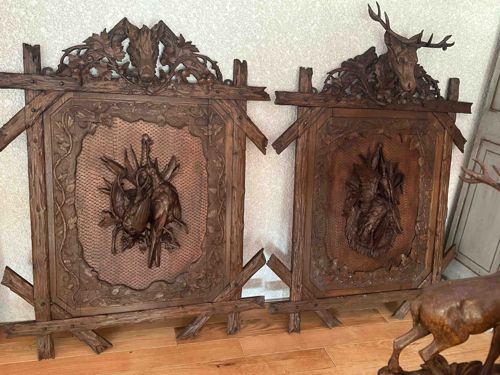
This appears to be a pair of large, elaborately carved antique Black Forest style wooden fireplace screens, or possibly highly decorative room dividers/panels. Each panel is constructed primarily of dark wood, likely oak or walnut, exhibiting a rich, deep patina consistent with age. The overall construction suggests a robust and substantial build. The dimensions appear significant, likely standing over three feet tall each. Each panel features a central, recessed rectangular area with a finely carved bas-relief scene. The left panel depicts a still life of game birds and a hunting horn, meticulously detailed, suggesting a bounty from the hunt. The right panel features a similar hunting motif, possibly depicting a deer head or a similar game animal amidst foliage. Surrounding these central scenes, the panels are framed by heavily carved borders mimicking naturalistic elements such as branches, leaves (possibly oak or acanthus), and vines, some with three-dimensional depth. The top of each panel is crowned with an impressive, prominent carving: the left features a wild boar's head emerging from an abundance of foliage, while the right displays an equally detailed stag's head with antlers, also surrounded by carved botanical elements. These animal heads serve as significant focal points and are characteristic of the Black Forest carving tradition. The supporting structures, visible at the sides and bottom, consist of rough-hewn, branch-like pieces of wood, adding to the rustic and naturalistic aesthetic. Some visible elements suggest traditional joinery, possibly mortise and tenon, secured with visible wooden pegs or nails. The condition shows a desirable aged patina, with some visible wear consistent with antique items, but no major damage or repairs are immediately evident. The craftsmanship is of high quality, characterized by intricate detail, deep carving, and a masterful execution of natural forms, indicating a skilled artisan. These pieces likely date from the late 19th to early 20th century, a peak period for Black Forest wood carving.
AI Appraisal Report
Based on my visual examination of the provided image, this pair of Black Forest style carved wooden hunting theme panels, likely serving as fireplace screens, appears to be an authentic representation of the genre. The intricate carving, particularly the three-dimensional rendering of the boar and stag heads, along with the detailed bas-relief hunting scenes and naturalistic framing elements, strongly align with the high-quality craftsmanship characteristic of Black Forest carving from the late 19th to early 20th century. The dark patina and visible wear appear consistent with age, suggesting no significant damage or repairs. The use of rough-hewn, branch-like support elements further reinforces their period authenticity and rustic aesthetic.
In terms of market conditions, there is a consistent, albeit niche, demand for quality Black Forest carvings. Pieces of this scale and intricate detail, especially a matching pair, are less common than smaller items. Comparables for such substantial and well-executed panels typically trade in the mid-to-high thousands. The rarity lies in finding such a complete and well-preserved pair with animal head finials. Factors significantly impacting value include their impressive size, the high artistic merit of the carving, and the excellent apparent condition.
It is crucial to note that this assessment is based solely on visual examination of the image. For full authentication, an in-person physical examination would be necessary to assess the exact wood species, confirm joinery techniques, and detect any potential hidden repairs or modern alterations. Microscopic analysis of the patina and wood fiber could confirm age. Provenance documentation, if available, would significantly enhance authenticity verification, but without it, the visual cues are very strong indicators of period authenticity. I am confident that these are genuine, high-quality examples.