AI Appraisal Estimate

AI-generated estimates · not official valuations

From the user

What was submitted

Photo and notes provided by the user — not generated by AI

Submitted item photo
Submitted photo · June 6, 2026

User's notes

No additional notes provided.

AI analysis below

AI appraisal

AI analysis & estimate

AI-Generated · Verify before acting

Everything below is generated by AI for informational purposes only. AI can make mistakes — the AI may misidentify items or misattribute them (artist, maker, brand, designer, origin, era). This is not an official valuation and should not be used for insurance, sale, tax, estate, legal, or lending purposes — or any decision requiring a certified appraisal. It is not an authoritative claim about any person, brand, or rights holder — do not share or rely on it as a factual statement about a third party. Always consult qualified professionals before making financial decisions.

Read the full disclaimer

AI Identification

·Not independently authenticated·Verify before acting

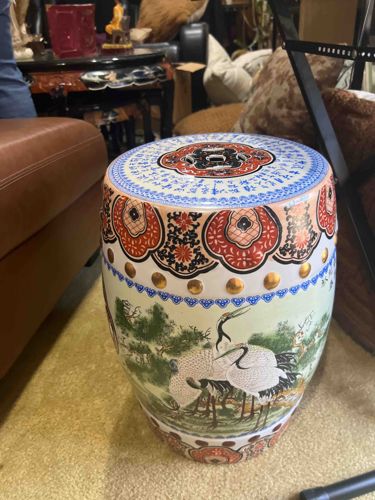
Japanese Imari-Style Porcelain Garden Stool

Asian Decorative Arts / Furniture

AI Estimated Value

·Not an official valuation·Verify before acting

$400.00 - $650.00

As of June 6, 2026

AI Item Analysis

·AI can make mistakes·Verify before acting
This is a barrel-shaped glazed porcelain garden stool featuring a complex decorative program. The central body is adorned with a hand-painted landscape scene depicting cranes (a symbol of longevity) amidst pine trees and marshland, executed in a palette of soft greens, blacks, and whites. The upper and lower registers are defined by traditional Imari-inspired 'maki-e' style borders, utilizing a bold iron-red, navy blue, and black color scheme with gold-toned raised 'bosses' or studs that simulate metal upholstery nails. The flat top surface includes a central openwork 'cash-coin' cutout for drainage or ease of transport, surrounded by concentric bands of geometric patterns and a ring of blue-inked calligraphic characters. Physically, the piece stands approximately 18 inches tall and exhibits a high-gloss vitreous glaze. While the style draws from Edo-period traditions, the crispness of the transfer-print outlines combined with hand-painted fills suggests a 20th-century production, likely mid-to-late Showa period. The condition appears excellent with no visible cracks or significant chips, though minor shelf wear on the unglazed base ring is expected. The craftsmanship shows high-quality mass-market production standards with careful attention to symmetry and alignment of the intricate motifs.

AI Appraisal Report

·AI can make mistakes·Verify before acting
I have virtually examined this barrel-shaped Imari-style porcelain garden stool. The piece demonstrates a high level of decorative complexity, combining longevity symbolism through crane and pine motifs with a classic iron-red and cobalt blue palette. While the design echoes the Edo-period Arita traditions, the uniformity of the glaze and the presence of transfer-printed outlines beneath the hand-painted enamels indicate this is a mid-to-late 20th-century production, likely from the Showa era. The condition appears exemplary with no visible crazing, chips, or restoration, though my assessment is limited to the visible surfaces; the unglazed foot-ring was not fully inspected for concealed firing cracks. The market for mid-century Japanese ceramics remains stable, though value is currently driven more by interior design utility than by high-level collector rarity. Similar export-quality stools typically realize prices in the $400 to $650 range at regional auction houses. Factors such as the 'cash-coin' openwork and the calligraphic ring on the top surface add to its decorative appeal. However, a definitive valuation is hindered by the lack of a physical inspection. A full authentication would require examining the clay body's density and weight to confirm it is not a modern slip-cast reproduction, as well as an inspection of any potter's marks or kilns stamps on the underside. Provenance documentation or a purchase receipt from the mid-20th century would further solidify its age and origin.

Get your items appraised

Instant estimates of your treasures with AI-powered appraisals

Browse More Appraisals