AI estimate as of July 23, 2025 · verify with a professional before acting
AI-Generated · Verify before acting
Everything on this page is generated by AI for informational purposes only. AI can make mistakes — the AI may misidentify items or misattribute them (artist, maker, brand, designer, origin, era). This is not an official valuation and should not be used for insurance, sale, tax, estate, legal, or lending purposes — or any decision requiring a certified appraisal. It is not an authoritative claim about any person, brand, or rights holder — do not share or rely on it as a factual statement about a third party. Always consult qualified professionals before making financial decisions.
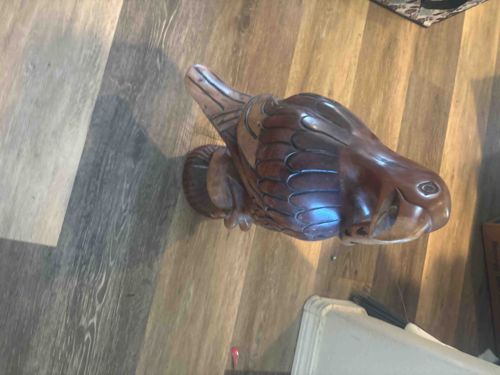
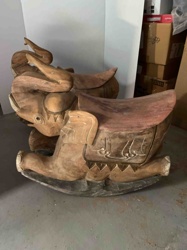
The item is a carved wooden sculpture depicting the head of a griffin or an eagle, likely functioning as a decorative architectural element, a newel post finial, or part of a larger furniture piece. It is crafted from a rich, dark brown wood, possibly mahogany or a similar hardwood, with a smooth, polished finish that reflects light. The carving is highly detailed, particularly in rendering the feathers around the neck and head. These feathers are depicted with distinct, individual contours, suggesting a skilled hand. The eye socket is rendered with a prominent brow, and there is a visible, possibly inlaid or carved, eye detail within. The beak is strong and hooked, characteristic of a raptor. The carving exhibits good craftsmanship with smooth lines and well-defined features, indicating machine-assisted carving or skilled hand-carving. There are no obvious signs of significant damage such as cracks or chips, though minor surface wear consistent with age and handling might be present, manifesting as slight dulling of the finish or minor scuffs not clearly visible in the provided image. The reverse or base of the carving, not fully visible, would determine its exact function (e.g., if it has a flat base for display, or a tenon for attachment). Given its style and the quality of carving, it likely dates from the late 19th to early 20th century, possibly as part of Victorian or Edwardian era decor, known for their elaborate wood carvings and mythological motifs. There are no visible maker's marks or signatures.
AI Appraisal Report
Upon visual examination of the provided image, this carved wooden sculpture, depicting a griffin or eagle head, presents as a well-crafted decorative element, likely from the late 19th or early 20th century. The quality of the carving, particularly the detailed feather work and strong facial features, suggests a skilled artisan or a high-quality machine-assisted production common in the Victorian or Edwardian periods. The wood appears to be a dense hardwood, like mahogany or walnut, with a good-quality original or early finish. The condition seems excellent, with no major chips, cracks, or repairs visible. The primary factors influencing its value are craftsmanship, condition, and decorative appeal. The market for architectural salvage and antique decorative arts remains steady, with pieces like this sought after for interior design projects. Rarity is moderate; while not unique, high-quality examples are uncommon. The lack of a maker's mark or signature prevents attribution to a specific workshop, which limits its value compared to a signed piece. A key value determinant is its original function; a newel post finial or part of a significant piece of furniture by a known maker would command a higher price than a standalone decorative carving. Without physical inspection, I cannot confirm the wood species, verify the age of the finish, or check for subtle repairs. Full authentication would require in-person examination to assess tool marks, wood grain, and patina, as well as any provenance documentation to trace its history.