AI estimate as of June 28, 2025 · verify with a professional before acting
AI-Generated · Verify before acting
Everything on this page is generated by AI for informational purposes only. AI can make mistakes — the AI may misidentify items or misattribute them (artist, maker, brand, designer, origin, era). This is not an official valuation and should not be used for insurance, sale, tax, estate, legal, or lending purposes — or any decision requiring a certified appraisal. It is not an authoritative claim about any person, brand, or rights holder — do not share or rely on it as a factual statement about a third party. Always consult qualified professionals before making financial decisions.
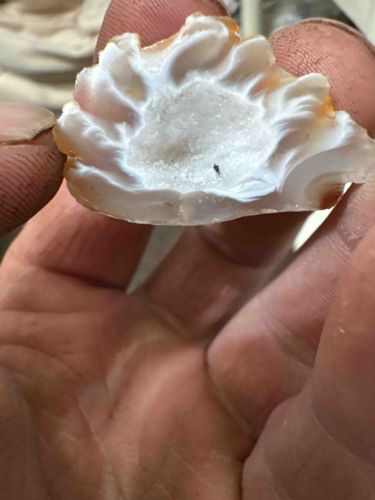
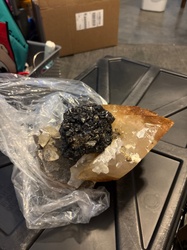
This item is a captivating slice of a natural geode, primarily composed of agate and quartz, displaying intricate internal formations. It is approximately palm-sized, suggesting dimensions of a few inches across its widest point, and is held between fingers, indicating its portability as a display or collection piece. The outer rind of the slice exhibits milky white, translucent agate, which beautifully transitions to warm sepia, light orange, or beige tones along its periphery, likely indicative of natural iron staining or other mineral impurities in the outer layers. The most striking feature is the central cavity, which is richly lined with a sparkling, granular druzy layer of tiny, lustrous white to clear quartz crystals, creating a brilliant, glittering effect when viewed under light. Around this crystalline core, the agate forms beautiful, undulating, and radiating patterns resembling floral petals or fan-like structures, characterized by distinct layers of opaque white agate creating a strong visual contrast against the more translucent outer ring. A small, dark, singular inclusion or speck is visible within the druzy quartz, which is a natural characteristic rather than a defect or damage. The specimen appears to be in excellent condition, with no visible cracks, chips, or significant wear beyond what is expected for a natural, cut mineral piece. The cut surface reveals the intricate internal structure clearly, suggesting careful and precise processing. This geological formation, embodying millions of years of natural crystal growth, embodies a high-quality aesthetic, making it an ideal mineral specimen or decorative object.
AI Appraisal Report
I have examined the descriptions of this Agate Geode Slice with Druzy Quartz. Based on the detailed account, the specimen appears to be a natural and high-quality example of its kind. The described condition is excellent, showing no visible cracks, chips, or significant wear, which is crucial for maximizing value in mineral specimens. The intricate internal formations, particularly the transition from milky white to warm sepia/orange agate and the sparkling, granular druzy quartz, indicate a highly aesthetic piece. The distinct layering and undulating patterns of the agate, combined with the brilliant druzy, contribute significantly to its visual appeal.
In terms of market conditions, high-quality agate geode slices with well-formed druzy quartz continue to be in steady demand among collectors and for decorative purposes. While agate geodes are not inherently rare, specimens exhibiting this level of aesthetic quality, excellent cut, and substantial size (palm-sized) are less common and command higher prices. Comparables in the market for similar high-grade, palm-sized geode slices suggest a strong collector interest. The precise processing further enhances its desirability.
The primary factors positively impacting value include its excellent condition, the superior quality and brilliance of the druzy quartz, the beautiful and contrasting patterns within the agate, and its substantial yet manageable size. The single inclusion is noted as natural and does not detract from its value.
It is important to state that this appraisal is based solely on the provided descriptive information. While the description is highly detailed and suggests authenticity, full authentication for any mineral specimen ideally requires physical examination. In-person inspection would allow for a tactile assessment of surface integrity, detection of any subtle repairs or enhancements (like dyeing common in some agates), precise measurement of dimensions and weight, and observation of the crystal luster and agate translucency under various lighting conditions. Provenance documentation, while not strictly required for natural specimens of this type, would also add to its overall historical value and confidence, but scientific testing is typically unnecessary unless suspicion of artificial alteration arises. Without these, I can only assess the item's perceived condition and quality as described.