These notes were written by the person who submitted this item. Appraiser.AI has not verified them, and the AI's identification and estimate may rely on them.
AI Estimated Value
Not an official valuation
$350-500
AI estimate as of July 10, 2025 · verify with a professional before acting
AI-Generated · Verify before acting
Everything on this page is generated by AI for informational purposes only. AI can make mistakes — the AI may misidentify items or misattribute them (artist, maker, brand, designer, origin, era). This is not an official valuation and should not be used for insurance, sale, tax, estate, legal, or lending purposes — or any decision requiring a certified appraisal. It is not an authoritative claim about any person, brand, or rights holder — do not share or rely on it as a factual statement about a third party. Always consult qualified professionals before making financial decisions.
This analysis also relies on unverified notes provided by the user, which may be incomplete or inaccurate and could affect the result.
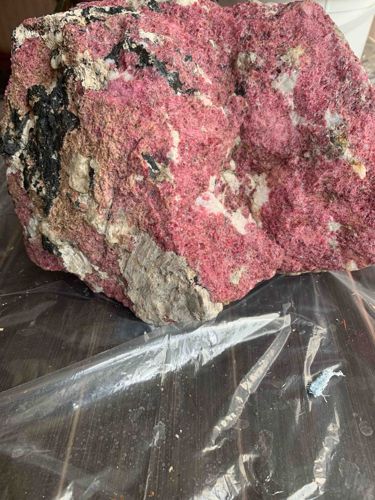
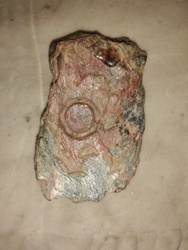
This is a substantial rough specimen of what appears to be Rhodonite, a manganese inosilicate mineral, presented as a large, unpolished rock. The dominant color is a vibrant rose-pink to reddish-pink, which covers a significant portion of the specimen, indicative of its composition. Interspersed within the pink matrix are prominent areas of black mineral inclusions, likely manganese oxides such as Franklinite or Manganese Pyrolusite, which create a striking contrast against the pink. There are also notable sections of a lighter, off-white to grayish material, possibly quartz, feldspar, or a weathered matrix, adding to the visual complexity. The surface texture is rough and uneven, characteristic of a naturally occurring mineral formation that has not undergone any significant cutting, shaping, or polishing. The various mineral components exhibit different crystalline structures, contributing to the overall irregular, granular appearance. There are no discernible maker's marks, signatures, or stamps, which is typical for a raw mineral specimen. The condition appears to be natural, primarily exhibiting the inherent rough edges and fractures of an unearthed mineral, with no obvious signs of recent damage, repairs, or significant wear beyond what would be expected from a geological specimen. The estimated age is geological, dating back millions of years to its formation. Its unique aspect lies in the vivid coloration and the clear presence of multiple mineral types within a single large specimen, making it a desirable piece for collectors of minerals and geological samples. The craftsmanship is naturally occurring, reflecting the beauty and processes of natural mineral crystallization.
AI Appraisal Report
Based on my examination of the image and the provided details, this rough Rhodonite specimen presents as an authentic geological find. The vibrant rose-pink to reddish-pink coloration is characteristic of high-quality Rhodonite, and the prominent black inclusions, likely manganese oxides, create an appealing contrast. The presence of lighter, possibly quartz or feldspar, sections further supports its natural origin. The rough, unpolished surface and irregular granular texture are consistent with an unworked mineral specimen. Its condition appears excellent for a natural piece, showing typical geological fractures but no signs of recent damage or repair.
From a market perspective, large, visually striking Rhodonite specimens with good color saturation and contrasting inclusions are highly sought after by mineral collectors. While Rhodonite is not exceptionally rare, specimens of this size and aesthetic quality are less common. Current market trends for raw, unpolished mineral specimens favor those that are well-formed and exhibit a clear display of their primary mineral with interesting associated minerals. The unique aspect here is the combination of vivid color and multiple mineral types within a single, substantial piece.
However, it is crucial to state that full authentication based solely on images has limitations. While the visual indicators are strong, an in-person examination would allow for tactile assessment, specific gravity testing, and clearer observation of crystal habits. For definitive material identification and detailed analysis of associated minerals, scientific testing such as X-ray diffraction (XRD) or spectroscopy would be ideal. Provenance documentation, if available, detailing its origin, would also significantly enhance its verifiable authenticity and value. Without these, my assessment of authenticity is based on visual characteristics alone.