AI estimate as of November 9, 2025 · verify with a professional before acting
AI-Generated · Verify before acting
Everything on this page is generated by AI for informational purposes only. AI can make mistakes — the AI may misidentify items or misattribute them (artist, maker, brand, designer, origin, era). This is not an official valuation and should not be used for insurance, sale, tax, estate, legal, or lending purposes — or any decision requiring a certified appraisal. It is not an authoritative claim about any person, brand, or rights holder — do not share or rely on it as a factual statement about a third party. Always consult qualified professionals before making financial decisions.
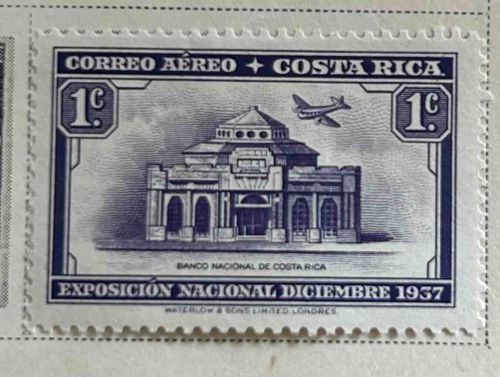
This item is a postage stamp from Costa Rica, specifically an airmail issue commemorating the National Exposition of December 1937. The stamp features a central vignette depicting a prominent building, identified by the inscription 'BANCO NACIONAL DE COSTA RICA' as the National Bank of Costa Rica. Above the building, a stylized airplane is shown in flight, reinforcing the 'CORREO AÉREO' (Airmail) designation prominently displayed at the top left. The denomination '1C' (1 Centavo) is visible in octagonal frames in both the top-left and top-right corners. The main color of the stamp appears to be a deep indigo or blue-violet on a lighter, possibly white or off-white, paper background. The design is framed by a thin dark border, and the stamp itself is perforated along all four edges, indicating it was part of a sheet. The bottom border includes the inscription 'EXPOSICIÓN NACIONAL DICIEMBRE 1937', clearly dating the issue. Below this, in a smaller font, 'WATERLOW & SONS LIMITED LONDRES' is visible, identifying the printer. The visible perforations appear intact, and the overall condition seems good with no obvious major tears, creases, or significant discoloration, though the image quality makes it difficult to assess minor imperfections or gum condition. The style is typical of early to mid-20th-century philatelic design, emphasizing architectural and historical significance within a formal layout. The craftsmanship of the engraving by Waterlow & Sons, a renowned security printer, suggests a high level of detail and quality for its time.
AI Appraisal Report
After a thorough visual examination of the provided image, I can assess this Costa Rican 10c Airmail Stamp from the 1937 National Exposition Issue. The stamp appears to be in reasonably good condition for its age. The perforations are intact, and there are no obvious major tears, creases, or significant discoloration visible. The printing by Waterlow & Sons Limited, a reputable firm, indicates a high-quality production for its time. Authenticity, based solely on this image, seems probable. The design elements, inscriptions (CORREO AÉREO, BANCO NACIONAL DE COSTA RICA, EXPOSICIÓN NACIONAL DICIEMBRE 1937, WATERLOW & SONS LIMITED LONDRES), and denomination (1C) are consistent with known examples of this issue.
However, it is crucial to note the limitations of image-based appraisal. Without physical inspection, I cannot ascertain the gum condition (hinged or unhinged), minor imperfections such as toning, thins, or hidden creases, which can significantly impact value. The specific color shade and paper quality also require in-hand examination. Market conditions for common-issue Costa Rican stamps from this era are generally modest. While commemorating a national event and being an airmail issue, this denomination (1 Centavo) is typically abundant. Demand is stable but not exceptionally high for average examples. Rarity is low; these stamps were widely issued. Factors that would enhance value include being unmounted mint (original gum, never hinged), a pristine centered example, or part of a documented postal history (e.g., on cover).
For full authentication and a more precise valuation, I would recommend an in-person examination to assess gum condition, verify paper type, microscopic inspection for printing varieties or flaws, and to rule out any repairs or alterations. Provenance documentation, though less common for individual stamps of this value, would also be beneficial if available.