AI estimate as of November 9, 2025 · verify with a professional before acting
AI-Generated · Verify before acting
Everything on this page is generated by AI for informational purposes only. AI can make mistakes — the AI may misidentify items or misattribute them (artist, maker, brand, designer, origin, era). This is not an official valuation and should not be used for insurance, sale, tax, estate, legal, or lending purposes — or any decision requiring a certified appraisal. It is not an authoritative claim about any person, brand, or rights holder — do not share or rely on it as a factual statement about a third party. Always consult qualified professionals before making financial decisions.
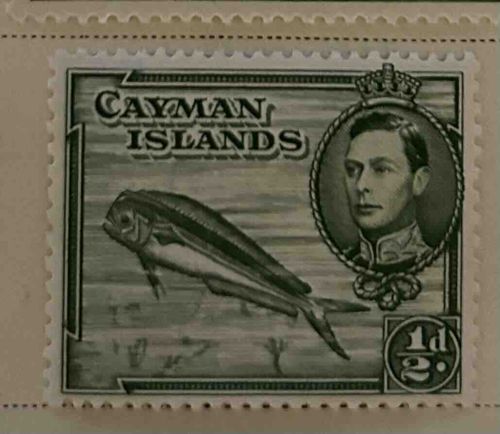
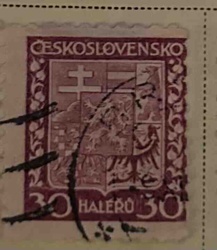
This item is a postage stamp from the Cayman Islands, featuring a portrait of King George VI and a dolphin-fish (or dorado). The stamp is rectangular with perforated edges, typical of postage stamps. The color scheme is monochromatic, primarily in shades of green-grey or possibly black and white, giving it a classic and somewhat somber appearance. In the upper left quadrant, the words 'CAYMAN ISLANDS' are prominently displayed in a stylized, bold font. The portrait of King George VI is enclosed within a circular frame on the upper right side, surmounted by a crown, indicating its origin as a colonial issue during his reign. Below the portrait, in the lower right corner, the denomination '1 1/2d' is clearly visible, likely indicating 'one and a half pence.' The central and dominant image is that of a dolphin-fish, depicted in motion, swimming horizontally across the stamp, with its distinctive long dorsal fin and sleek body. The background behind the fish appears to be a textured water surface or stylized ocean, possibly with very faint depictions of underwater flora or coral. The overall condition appears to be excellent, with sharp perforations and clear printing, suggesting it is either uncirculated or exceptionally well-preserved. There are no visible tears, creases, or major discolorations. The craftsmanship is typical of government-issued philatelic items from the mid-20th century, with fine line engraving work on both the portrait and the fish, indicating a high level of detail and precision in its production. The presence of King George VI suggests an estimated age of between 1936 and 1952, corresponding to his reign.
AI Appraisal Report
I have visually examined the provided image of the Cayman Islands 1 1/2d stamp featuring King George VI and a dolphin-fish. Based on this visual inspection, the stamp appears to be in excellent condition, with sharp perforations and clear printing. There are no visible tears, creases, or major discolorations, which suggests it is either uncirculated or very well-preserved. The craftsmanship is consistent with mid-20th-century philatelic items.
This specific stamp issue, depicting King George VI, places its origin within his reign (1936-1952). While the design is aesthetically pleasing, stamps from the British colonial era, especially those in common denominations like 1 1/2d, were generally issued in very large quantities. As such, they are not typically rare unless they possess specific varieties (e.g., errors, plate flaws) or extremely fine centering that is unusual for the issue.
Based on current market conditions for similar common issues from the Cayman Islands during the King George VI era, a stamp in the described condition would likely fall into the lower-to-mid range of collector value. The demand for common King George VI issues is steady but not particularly high. Unmounted mint examples, if confirmed, would command a slightly higher value than hinged or used examples.
It is crucial to state that this appraisal is based solely on the provided image. While the condition appears excellent, I cannot definitively verify its authenticity, gum condition (mounted mint, unmounted mint, regummed), or detect any subtle flaws (e.g., thins, repairs, small toning spots, minor creases) that would significantly impact value without a physical in-person examination. For full authentication and a more precise valuation, I would require a direct physical inspection, potentially including examination under magnification, and assessment of the gum and paper condition.