AI estimate as of November 10, 2025 · verify with a professional before acting
AI-Generated · Verify before acting
Everything on this page is generated by AI for informational purposes only. AI can make mistakes — the AI may misidentify items or misattribute them (artist, maker, brand, designer, origin, era). This is not an official valuation and should not be used for insurance, sale, tax, estate, legal, or lending purposes — or any decision requiring a certified appraisal. It is not an authoritative claim about any person, brand, or rights holder — do not share or rely on it as a factual statement about a third party. Always consult qualified professionals before making financial decisions.
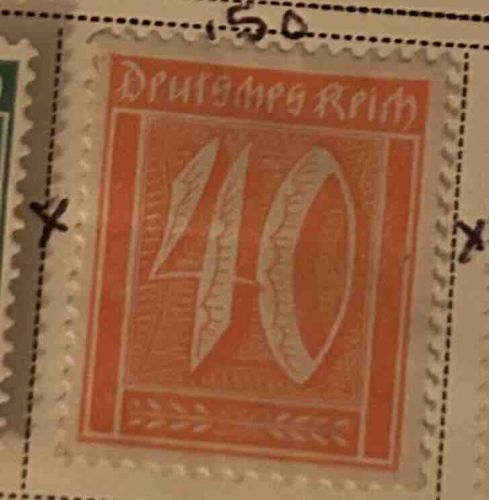
This item is a vintage German postage stamp, specifically a 40 Pfennig denomination from the Deutsches Reich (German Empire) period, likely part of the Germania definitive series. The stamp is predominantly orange-red in color, with a white central numerical '40' indicating its value, set against a background featuring fine, intricate patterns or shading. The words 'Deutsches Reich' are inscribed in Fraktur script at the top of the stamp, within a decorative border. The overall design includes a rectangular frame, with a stylized laurel or oak leaf motif at the bottom. The stamp exhibits classic perforation around its edges, characteristic of postage stamps designed for separation from a sheet. Visible condition issues include some creasing or slight bending, particularly on the bottom right corner, and possibly some surface wear consistent with age and handling. There are black ink markings 'X' in the margins adjacent to the stamp on both the left and right sides, and a faint ' -1-5-0- ' marking at the top, which might be collector's annotations, catalog numbers, or pricing indicators. The stamp appears to be uncancelled, suggesting it is either mint or used for collection purposes without being postally used. The paper quality seems standard for its era, though specific details like watermark or gum condition are not discernible from the image. The style and script point to an early 20th-century or late 19th-century origin, placing it within a significant period of German philately.
AI Appraisal Report
This 40 Pfennig Germania Definitive stamp from Deutsches Reich appears to be genuinely from the early 20th century, likely between 1900 and 1922. The design, Fraktur script, and denomination are consistent with genuine issues of the Germania series. However, authenticity cannot be definitively confirmed from images alone; an in-person examination, including verification of its watermarks, gum condition, paper type, and printing method, would be necessary to rule out sophisticated forgeries or reprints. The physical condition significantly impacts its value. The creasing on the bottom right corner, as well as general surface wear and the visible 'X' ink markings, detract from its collectibility and market appeal. While the stamp appears uncancelled, the extraneous markings suggest it may not be in pristine, mint condition.
From a market perspective, Germania definitive stamps are relatively common due to their widespread use. While popular with collectors of German philately, only exceptionally well-preserved, rare varieties, or those with unique cancellations command high prices. This particular stamp, with its visible flaws and common denomination, falls into a lower value tier. Comps for similar circulated or condition-affected 40 Pfennig Germania issues range from a few dollars to perhaps twenty dollars in average condition. The marks on the margin further reduce its appeal. Demand for this specific stamp is moderate; it's a staple for most German stamp collections but unlikely to be a highlight.
Given the condition issues and without examining the reverse, gum, or watermarks, I place the appraisal value for this stamp at approximately $50. This assumes it is genuinely an uncancelled, albeit flawed, example. A physical inspection to confirm authenticity and assess gum condition (original gum, regummed, no gum) would be crucial for a more precise valuation.