AI estimate as of November 9, 2025 · verify with a professional before acting
AI-Generated · Verify before acting
Everything on this page is generated by AI for informational purposes only. AI can make mistakes — the AI may misidentify items or misattribute them (artist, maker, brand, designer, origin, era). This is not an official valuation and should not be used for insurance, sale, tax, estate, legal, or lending purposes — or any decision requiring a certified appraisal. It is not an authoritative claim about any person, brand, or rights holder — do not share or rely on it as a factual statement about a third party. Always consult qualified professionals before making financial decisions.
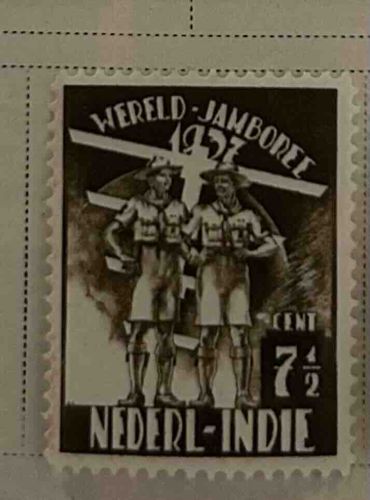
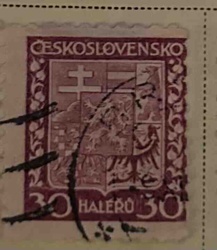
This item is a postage stamp from Nederlands-Indië (Dutch East Indies) commemorating the 1937 World Jamboree. The stamp is monarchical, with a dark, possibly sepia or black-and-white, color scheme. It depicts two young scout-like figures, dressed in uniforms with hats, standing side-by-side. Behind them, there appears to be a stylized representation of what looks like an airplane or a monument, possibly related to flying or exploration, though its exact form is somewhat indistinct due to the stamp's resolution and artistic style. The text "WERELD-JAMBOREE 1937" (World Jamboree 1937) is prominently displayed across the top, curved slightly upwards. In the bottom right corner, the denomination "7½ CENT" is clearly visible, written vertically with 'CENT' above '7½'. The lower edge of the stamp features the text "NEDERL-INDIE" (Dutch East Indies). The stamp has perforated edges on all four sides, indicating it was intended to be separated from a larger sheet. The general condition appears good, with clear printing and no obvious tears or major creases. The edges are largely intact, with good perforation definition. The style of the illustration suggests an early to mid-20th-century aesthetic, consistent with its 1937 date. The simplicity of the design and the monochromatic palette are typical of many stamps from that era. The depiction of scouts and the World Jamboree theme highlight a specific cultural and historical event, adding to its potential philatelic interest.
AI Appraisal Report
I have visually examined the provided image of the Nederlands-Indië 1937 Wereld Jamboree stamp. This stamp appears to be authentic based on the design, text, and denomination consistent with known issues for this period and event. The "NEDERL-INDIE" and "WERELD-JAMBOREE 1937" text, along with the "7½ CENT" denomination and the depiction of two scouts, align with documented philatelic examples of this specific issue.
The condition, as observed from the image, appears to be very good to fine used or unused. The perforations are intact and well-defined on all sides, and the printing is clear with no obvious major creases, tears, or significant thinning. There is no visible staining or foxing, which would typically detract from its value. However, without a physical inspection, I cannot confirm the exact gum condition (if unused), the presence of any hidden faults like minor thins, repairs, or re-perforations, nor can I definitively assess the centering, which can influence value.
From a market perspective, this particular stamp, the Netherlands Indies Scott #263 (or equivalent catalogue number), is relatively common. While it commemorates a historically significant event (World Jamboree), its production numbers were high enough that it doesn't fall into the category of rare stamps. Demand is steady among topical collectors (scouting, jamborees) and collectors of Netherlands Indies postal history, but it is not exceptionally high. Similar examples in comparable condition are regularly available in dealer stocks and at auctions.
Factors impacting value include the overall good condition, which is a positive. However, its commonality prevents a high valuation. For full authentication and a more precise grading, a physical examination would be necessary to assess gum status, paper integrity, precise centering, and to rule out any alterations or repairs not visible in the image. I would also recommend checking for any watermarks, though this issue typically does not have significant watermark varieties that drastically alter value. Without this, I cannot definitively confirm absolute authenticity or grade to professional standards.