AI Appraisal Estimate

AI-generated estimates · not official valuations

From the user

What was submitted

Photo and notes provided by the user — not generated by AI

Submitted item photo
Submitted photo · June 13, 2026

User's notes

No additional notes provided.

AI analysis below

AI appraisal

AI analysis & estimate

AI-Generated · Verify before acting

Everything below is generated by AI for informational purposes only. AI can make mistakes — the AI may misidentify items or misattribute them (artist, maker, brand, designer, origin, era). This is not an official valuation and should not be used for insurance, sale, tax, estate, legal, or lending purposes — or any decision requiring a certified appraisal. It is not an authoritative claim about any person, brand, or rights holder — do not share or rely on it as a factual statement about a third party. Always consult qualified professionals before making financial decisions.

Read the full disclaimer

AI Identification

·Not independently authenticated·Verify before acting

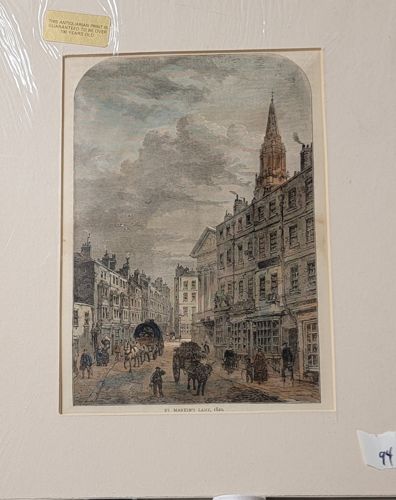
Hand-Colored Engraving of St. Martin's Lane, 1820

Antique Prints and Works on Paper

AI Estimated Value

·Not an official valuation·Verify before acting

$45.00-$75.00

As of June 13, 2026

AI Item Analysis

·AI can make mistakes·Verify before acting
This is a hand-colored antiquarian engraving depicting a bustling street scene in St. Martin's Lane, London, dated 1820. The artwork is presented in a vertical orientation with an arched top edge, a common stylistic choice for 19th-century book illustrations. Physically, the print is rendered on aged cream-colored paper, featuring delicate line work characteristic of steel or copper plate engraving, enhanced by a professional wash of watercolors including muted blues in the sky, earthy browns for the architecture, and subtle reds for the figures. The composition showcases horse-drawn carriages and pedestrians moving through a narrow lane flanked by multi-story Georgian-style buildings, with the prominent spire of St Martin-in-the-Fields church visible in the background. Notable features include the printed caption 'ST. MARTIN'S LANE, 1820' at the bottom center. The condition appears fair to good for its age; there is visible toning and minor foxing consistent with a piece over 100 years old, as indicated by the gold authenticity sticker on the matting. The print is housed in a modern off-white mat board and wrapped in protective plastic. The fine detail in the architectural moldings and the lively rendering of everyday life suggest it was created by an experienced engraver, potentially for a historical topographical publication of early 19th-century London.
AI Appraisal Report

·AI can make mistakes·Verify before acting
I have conducted a visual examination of the hand-colored engraving titled 'ST. MARTIN'S LANE, 1820.' The piece reflects the aesthetic of 19th-century topographical book illustrations. The architectural detail of St Martin-in-the-Fields and the bustling street life are rendered with professional line work. Condition is fair to good; I observe significant toning, minor foxing, and acid-burn staining along the edges of the image, likely caused by historic contact with non-archival mounting materials. While a 'gold authenticity sticker' is present on the matting, it belongs to a modern gallery rather than a recognized historical registry, serving as a retail provenance rather than a formal certificate of antiquity. The market for general topographical prints of London from this era is currently saturated. While charming, these prints were often mass-produced for city histories or periodicals. Comparable sales for mid-sized, hand-colored engravings from the Regency period typically fall within the $40 to $80 range at auction. Factors limiting value include the visible foxing and the fact that the 'arched top' suggests it was trimmed from a larger folio or extracted from a book, which can reduce its value compared to a full-plate sheet. It's crucial to note that via digital image, I cannot confirm the paper’s watermark or distinguish between a true 19th-century plate strike and a high-quality mid-20th-century restrike. A physical inspection is required to analyze the paper’s fiber and the 'plate mark' indentation. Full authentication would require removing the print from the modern mat to inspect the reverse for hinge marks and paper quality, alongside provenance records documenting its chain of ownership.

Get your items appraised

Instant estimates of your treasures with AI-powered appraisals

Browse More Appraisals