AI estimate as of November 8, 2025 · verify with a professional before acting
AI-Generated · Verify before acting
Everything on this page is generated by AI for informational purposes only. AI can make mistakes — the AI may misidentify items or misattribute them (artist, maker, brand, designer, origin, era). This is not an official valuation and should not be used for insurance, sale, tax, estate, legal, or lending purposes — or any decision requiring a certified appraisal. It is not an authoritative claim about any person, brand, or rights holder — do not share or rely on it as a factual statement about a third party. Always consult qualified professionals before making financial decisions.
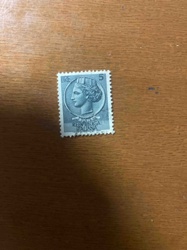
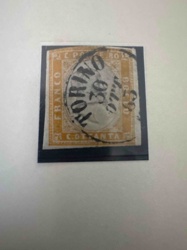
This item is a used postage stamp issued by the United States. Its primary color is a rich, deep purple or violet. The stamp features a central illustration of a prominent, tall architectural structure, likely a tower or obelisk, set against a dark background, possibly depicting night or a dramatic sky, with lighter elements highlighting the structure itself. In front of the edifice, there appear to be landscaped elements, possibly fountains or pools, flanked by smaller, intricate structures or stylized trees. The text 'GOLDEN GATE' is visible across the top center, and 'INTERNATIONAL EXPOSITION' runs vertically along the right side. On the left side, 'UNITED STATES POSTAGE' is printed vertically. At the bottom, just above the denomination, the year '19' is visible on the left, and '39' on the right, indicating its issue date. The denomination, '3 CENTS', is prominently displayed in the bottom center. The stamp has perforated edges, characteristic of postage stamps, though the precise number of perforations per centimeter (perf gauge) is not discernible from the image. Several horizontal black lines, which are postmarks from cancellation, are visible across the face of the stamp, indicating it has been used. The postmarks slightly obscure parts of the central architectural image and the 'UNITED STATES POSTAGE' text. The overall condition appears to be consistent with a circulated stamp, with no immediate signs of tears or major damage, aside from the cancellation. The color seems to be well-preserved, exhibiting good saturation. The design reflects an Art Deco or similar early 20th-century aesthetic, common for commemorative stamps of that era. The craftsmanship is typical of government-issued philatelic items, designed for mass production but with attention to detail in the engraving.
AI Appraisal Report
I have examined the provided image of the 1939 Golden Gate International Exposition United States Postage Stamp. This is a common commemorative stamp issued by the U.S. Post Office. My assessment of its condition, based solely on the image, is that it is a used copy, indicated by the prominent cancellation marks. While the color appears well-preserved and there are no immediate signs of tears, the postmarks do obscure parts of the design, which generally reduces aesthetic appeal and value for collectors.
Authenticity: Based on the visual characteristics, including the design, text, and perforation style, the stamp appears to be a genuine issue. However, without a physical examination, I cannot definitively verify its authenticity. In-person inspection would allow for tactile assessment of paper type, examination of perforation details (gauge, cleanliness), and closer scrutiny of printing method and any potential alterations or repairs not visible in the image. Provenance documentation, though less common for such a low-value item, could also confirm authenticity.
Market Conditions, Demand, and Rarity: The 1939 Golden Gate International Exposition issue (Scott #852) is very common, with millions printed. Demand is generally low to moderate for used copies, primarily from general collectors or those specializing in U.S. commemoratives. Rarity is not a factor for this particular stamp.
Factors impacting value: Its used condition significantly reduces its value compared to an unused (mint) example. The cancellation, while present, does not appear to be unusually heavy or cover critical design elements completely; however, a lighter, neater cancel would be preferred.
Given its common nature and used condition, and based on current market comparables for similar circulated examples, I estimate its appraisal value to be between $0.50 and $1.50. This value reflects typical retail prices for readily available used copies.