AI estimate as of September 19, 2025 · verify with a professional before acting
AI-Generated · Verify before acting
Everything on this page is generated by AI for informational purposes only. AI can make mistakes — the AI may misidentify items or misattribute them (artist, maker, brand, designer, origin, era). This is not an official valuation and should not be used for insurance, sale, tax, estate, legal, or lending purposes — or any decision requiring a certified appraisal. It is not an authoritative claim about any person, brand, or rights holder — do not share or rely on it as a factual statement about a third party. Always consult qualified professionals before making financial decisions.
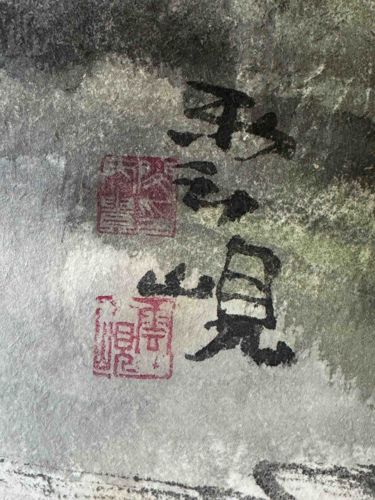
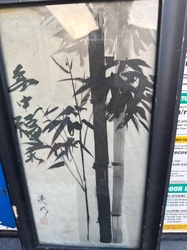
This item is a close-up image of what appears to be a section of a traditional Chinese artwork, likely a painting or scroll, featuring prominent black ink calligraphy alongside two distinct red seal impressions (chops). The background consists of a textured, mottled gray and white surface, indicative of rice paper or a similar fibrous Asian art paper, possibly suggesting a watercolor or ink wash technique applied to depict clouds, mist, or an ethereal landscape element. The calligraphy is executed in bold, fluid black brushstrokes, showing varying line thickness and dynamism, characteristic of expressive Chinese script. The characters are arranged vertically, with some appearing more stylized or cursive than others. Below and to the left of the main calligraphic text are two red seals. The upper seal is roughly square-shaped with intricate, possibly archaic or highly stylized characters within its border. The lower seal is also square or rectangular, positioned just to the left of the main calligraphy, and features similarly complex red characters. The impressions of these seals are clear, indicating a good transfer of ink. The paper itself shows subtle variations in tone and texture, which could be natural aging, part of the stylistic choice, or slight staining. There are no overt signs of damage like tears or creases visible within this cropped section, suggesting generally fair condition for an item of this type, though the overall impression is one of age and authenticity. The craftsmanship of both the calligraphy and the seal impressions points to a practiced hand, typical of traditional East Asian artistic expression. The specific content of the calligraphy and the seals would be crucial for dating and attributing the piece, but based purely on visual style, it appears to be a classical example of Chinese ink art, potentially from the late Qing dynasty or early to mid-20th century.
AI Appraisal Report
Based on my visual examination of the provided image, this piece of Chinese calligraphy and seals on rice paper exhibits characteristics consistent with traditional East Asian ink art. The calligraphy, executed in bold and fluid black brushstrokes, shows varying line thickness and dynamism, indicative of a practiced hand. The two distinct red seal impressions (chops) are clear and well-defined, further suggesting skilled artistry. The background's textured, mottled gray and white surface is typical of rice paper, possibly incorporating ink wash. The overall condition appears fair, with no visible tears or creases in this cropped section, implying a generally well-preserved state for its presumed age. Subtle variations in tone and texture are present, which could be natural aging or part of the artistic design.
Market conditions for traditional Chinese calligraphy are generally steady, particularly for works with clear artistic merit. Comparable pieces by unknown or less prominent artists, especially those lacking specific provenance, typically fall into a moderate price range. Demand is stable among collectors of Asian art. The rarity of this specific piece cannot be fully assessed without knowledge of the artist and the content of the calligraphy, though its visual quality suggests it is not a mass-produced item.
Factors significantly impacting value include the identity of the calligrapher, the meaning of the calligraphy, the historical significance of the seals, and the overall completeness of the artwork (e.g., if it's part of a larger scroll or album). Without understanding the exact characters and their context, only a general aesthetic appraisal is possible.
It is crucial to note the limitations of authenticity verification from images alone. A full authentication would require an in-person examination to assess paper quality, ink stability, and the physical characteristics of the seals. Provenance documentation, such as artist signatures, collector marks, or historical records, would be essential to attribute the work definitively and to determine its historical context. Scientific testing, such as analysis of ink composition or paper aging, could further assist in dating and verifying its authenticity. Without these, the current appraisal is based purely on the visual aesthetics and assumed traditional materials and techniques.