AI estimate as of November 10, 2025 · verify with a professional before acting
AI-Generated · Verify before acting
Everything on this page is generated by AI for informational purposes only. AI can make mistakes — the AI may misidentify items or misattribute them (artist, maker, brand, designer, origin, era). This is not an official valuation and should not be used for insurance, sale, tax, estate, legal, or lending purposes — or any decision requiring a certified appraisal. It is not an authoritative claim about any person, brand, or rights holder — do not share or rely on it as a factual statement about a third party. Always consult qualified professionals before making financial decisions.
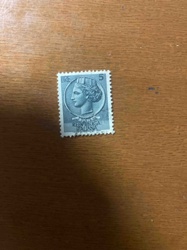
This is a used Greek postage stamp, likely from the Centenary of Greek Independence series issued in 1930. The stamp features a central vignette depicting a classical statue, which appears to be a male figure in drapery standing on a plinth. The primary color of the stamp is a pale teal or light blue, with the design elements slightly darker to provide contrast. The stamp has a classic rectangular shape with perforated edges, indicating it was torn from a sheet. Visible text includes "ΔΐΗΕ" (DRX - Drachmas, the former currency of Greece) in the upper left corner and "200" in the upper right, denoting its face value as 200 Drachmas. At the bottom, the word "ΕΛΛΑΣ" (ELLAS), meaning Greece, is prominently displayed. The borders of the stamp feature intricate decorative patterns, possibly floral or geometric motifs, adding to its visual appeal. The stamp exhibits clear evidence of being used, as indicated by a prominent black postmark diagonally across the lower left portion of the image. This postmark partially obscures some of the details but suggests it has fulfilled its postal purpose. The paper appears to be slightly yellowed with age, consistent with an item of this vintage. The perforations around the edges are mostly intact, though some may show minor wear or separation due to handling. The overall condition suggests moderate circulation, typical for a used stamp of this era, without major tears or significant damage, aside from the cancellation mark. The craftsmanship appears standard for postage stamps of the early 20th century, with finely printed details in the central image and border.
AI Appraisal Report
Upon examining the provided image of the Greek postage stamp, which appears to be from the Centenary of Greek Independence series (1930) with a 200 Drachma face value, I can offer the following appraisal. The stamp's visual condition suggests it is a used example, as evidenced by the clear black postmark diagonally across the lower left. The perforations appear largely intact, and while there's some age-related yellowing of the paper, there are no visible major tears or significant damage beyond the cancellation, indicating a moderately circulated condition typical for its age. Authenticity, based solely on this image, seems probable given the consistent design elements, text, and general appearance with known issues of this series. However, a definitive authentication would require in-person examination to verify paper type, printing methods, and watermark (if applicable), which are not discernible from the image.
From a market perspective, Greek stamps from this period, even key issues, are generally not exceedingly rare in used condition unless they possess specific varieties, unusual cancellations, or are in extremely fine condition. The Centenary of Greek Independence series is quite popular among Hellenic philatelists, but the 200 Drachma stamp in used condition is relatively common. Current market trends for common used examples of this specific stamp place its value in the lower range. Factors impacting this value include its used status, the clarity and type of postmark (though not fully legible here), and the overall centering and freshness of the color. Without a physical inspection, minor imperfections like thinning or hidden faults under the postmark cannot be ruled out, which could further affect value.
Given these considerations, I estimate the appraisal value of this stamp to be in the range of $5 to $15. This range accounts for its used condition and general market availability. An in-person examination to assess paper integrity, precise perforation condition, and potential watermarks would be crucial for a more precise valuation and to identify any hidden attributes or subtle characteristics that could significantly alter its value beyond this estimate.