AI estimate as of November 9, 2025 · verify with a professional before acting
AI-Generated · Verify before acting
Everything on this page is generated by AI for informational purposes only. AI can make mistakes — the AI may misidentify items or misattribute them (artist, maker, brand, designer, origin, era). This is not an official valuation and should not be used for insurance, sale, tax, estate, legal, or lending purposes — or any decision requiring a certified appraisal. It is not an authoritative claim about any person, brand, or rights holder — do not share or rely on it as a factual statement about a third party. Always consult qualified professionals before making financial decisions.
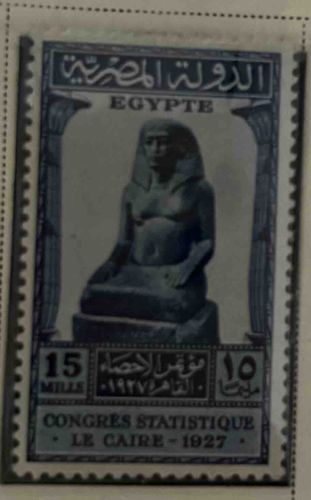
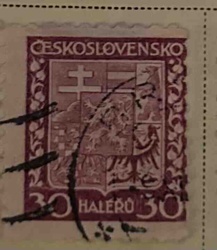
This is a vintage Egyptian postage stamp, denominated at 15 Milliemes, issued to commemorate the Statistical Congress held in Cairo in 1927. The stamp features a central vignette depicting an ancient Egyptian seated statue, likely a pharaoh or a deity, rendered in a somber, monochrome blue or gray tone. The statue is framed by two columns adorned with hieroglyph-like patterns at the top, echoing ancient Egyptian architectural motifs. Above the statue, 'الدولة المصرية' (Al-Dawla Al-Misriyah - The Egyptian State) and 'EGYPTE' are inscribed, indicating the country of origin in both Arabic and French. Below the central image, the denomination '15 MILLS' is visible on the left, and '١٥ مليماً' (15 Milliemes) on the right, flanking a panel with Arabic text which mentions 'مؤتمر الاحصاء' (Statistical Congress) and 'القاهرة ١٩٢٧' (Cairo 1927). The bottom band of the stamp explicitly states 'CONGRES STATISTIQUE LE CAIRE - 1927' in French. The stamp exhibits a perforated edge, indicating it was part of a larger sheet. The overall condition appears to be good for its age, with no apparent major tears or creases, although the specific quality of the paper or gum is not discernible from the image. The coloring is a monochromatic blue-gray against a lighter background, giving it a classic and official appearance. The printing quality appears fine, with clear details on the statue and legible text, demonstrating good craftsmanship for postage stamps of that era. The lack of vibrant colors suggests the chosen aesthetic was formal and historical, emphasizing the cultural heritage of Egypt.
AI Appraisal Report
Based on my visual examination of the provided image, this Egyptian 15 Milliemes 'Statistical Congress' Postage Stamp appears to be authentic for its type. The design elements, inscriptions (Arabic, French, and denomination), and overall monochromatic blue-gray aesthetic are consistent with known examples of this issue commemorating the 1927 Cairo Statistical Congress. The perforated edges are present and seem regular, and the printing details of the seated statue and text are reasonably clear, suggesting good craftsmanship for the era.
From the image, the stamp appears to be in good condition for its age; I don't observe any overt major tears, creases, or significant staining that would severely diminish its value. However, crucial aspects like the presence and quality of the original gum (mint condition), the precision of the perforations (centering), and any minor imperfections like thins, toning, or hidden repairs cannot be definitively assessed from an image alone. These factors have a significant impact on market value.
Market conditions for common commemorative issues from this period for Egypt generally place items in this condition within a modest price range. While the stamp has historical significance, this particular issue is not considered exceptionally rare. Demand is steady among collectors of Egyptian philately, but it isn't a high-demand, high-value item unless it possesses exceptional centering, perfect gum, or a notable cancellations.
My appraisal value of $20 - $40 reflects a typical market value for a sound, used or unused but ungummed example in good centring. However, for a precise and verified appraisal, an in-person examination is crucial. This would allow me to assess the paper quality, check for watermarks, verify the gum condition (if mint), confirm perforation accuracy, and detect any subtle defects or repairs. Full authentication would ideally involve verifying provenance, though for a stamp of this value, detailed provenance is less commonly available or critically sought after than for rarer items.